

How to Build a Data Quality Programme for Compliance
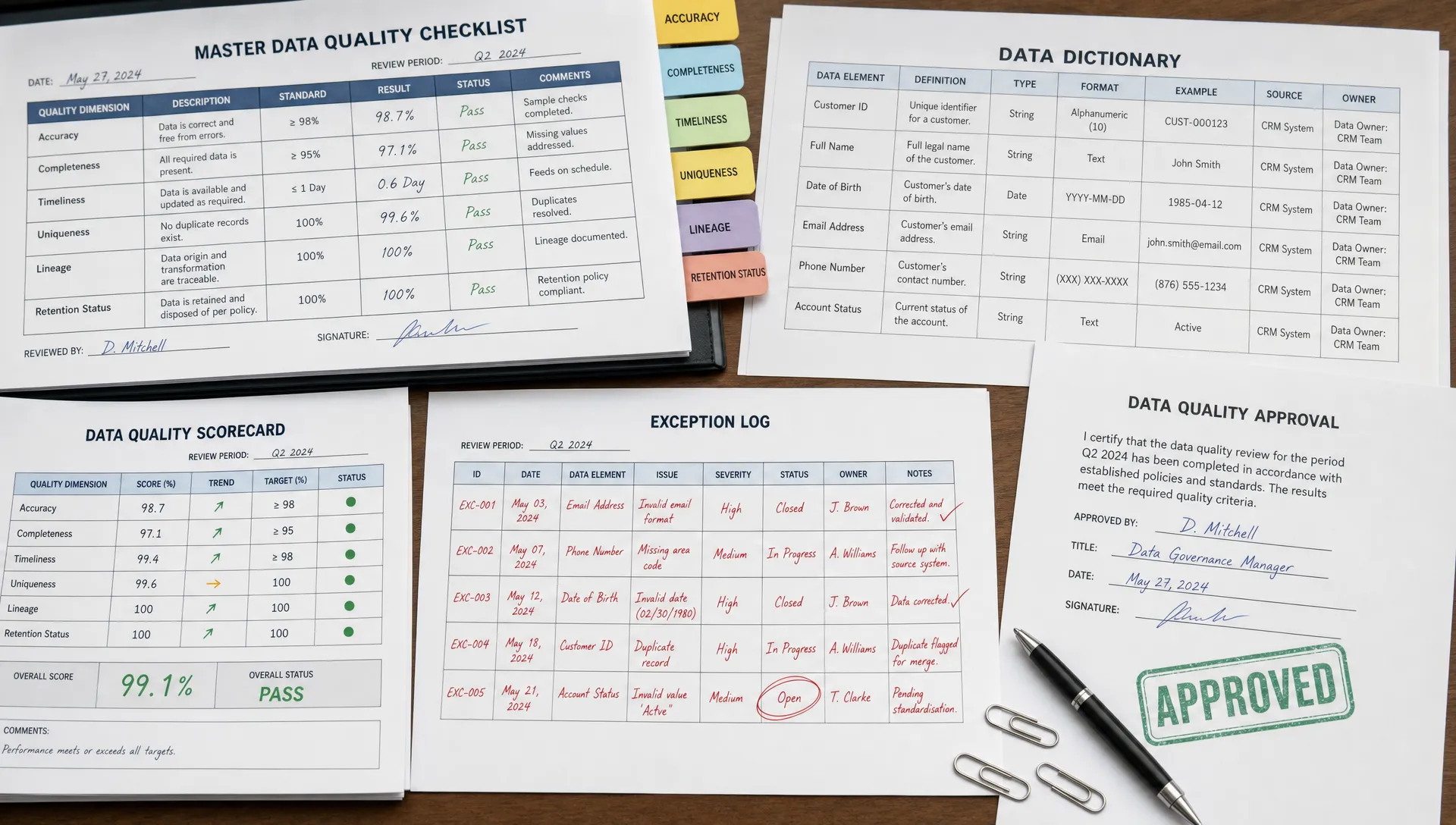
A data quality programme for compliance is not a technical clean-up exercise. It is a governance discipline that helps an organisation prove that the personal data it collects, uses, stores and shares is accurate, complete, current, traceable and fit for its lawful purpose.
For Jamaican organisations, this matters because the Data Protection Act, 2020 expects personal data to be handled in a way that supports fairness, accuracy, security, retention limits and accountability. Poor quality data can undermine all of those obligations. It can lead to incorrect customer records, incomplete consent histories, weak subject access responses, unreliable retention schedules, flawed anti-money laundering checks and audit findings that could have been prevented.
The aim is not perfection. The aim is controlled, measurable improvement in the data that carries the highest compliance risk.
Why data quality is a compliance issue
Many organisations treat data quality as an IT problem. In reality, compliance teams feel the consequences first.
If a customer record has the wrong address, privacy notices may not reach the right person. If a consent field is blank or inconsistent across systems, marketing decisions become risky. If employee data is duplicated, retention rules may be applied unevenly. If vendor records are incomplete, third-party risk reviews become unreliable. If beneficial ownership or customer due diligence data is inaccurate, anti-money laundering compliance can be weakened.
Data protection compliance depends on being able to answer practical questions with evidence:
What personal data do we hold?
Why do we hold it?
Where did it come from?
Who has access to it?
Is it accurate enough for the purpose?
How long should we keep it?
Can we correct, delete or restrict it when required?
If the underlying data is poor, the answers become uncertain. That uncertainty creates compliance risk.
A strong data quality programme gives structure to this work. It defines ownership, sets rules, measures the condition of key records and creates a repeatable process for fixing issues before they affect customers, employees, regulators or business decisions.
What a compliance-led data quality programme should cover
A useful programme does not try to fix every dataset at once. It focuses on the data elements that affect regulatory duties, customer rights, governance reporting and operational risk.
The following dimensions are a practical starting point.
Data quality dimension | Compliance meaning | Example risk if ignored |
Accuracy | Data reflects the real person, transaction or status | A customer receives decisions based on outdated or incorrect records |
Completeness | Required fields are populated | A subject access request cannot be answered fully |
Consistency | Data matches across systems and reports | Consent appears valid in one platform but absent in another |
Timeliness | Data is updated within an acceptable period | AML or customer due diligence data becomes stale |
Validity | Data follows approved formats and values | Free-text entries make reporting unreliable |
Uniqueness | Records are not duplicated without control | Retention rules are applied to one record but not another |
Lineage | The source, movement and transformation of data are known | The organisation cannot explain where a record came from |
Retention status | Data is linked to a retention rule or disposal decision | Personal data is kept longer than necessary |
These dimensions should be translated into rules that business teams can understand. “Completeness” is abstract. “Every active customer record must have a verified contact method and lawful basis field” is operational.
Step 1: Define scope around regulatory risk
The first mistake is trying to launch a data quality programme across the whole organisation. That usually creates meetings, templates and frustration before it creates results.
Start with the processes where poor data quality could cause the most compliance harm. For many organisations in Jamaica, these include customer onboarding, employee records, marketing databases, complaints handling, vendor management, AML due diligence, incident response and data subject rights requests.
If your organisation has not yet documented how personal data moves through these processes, start with a focused data map. A narrow approach is easier to complete and test. PLMC has outlined a practical way to begin in its guidance on starting a data mapping project, which is a useful foundation for deciding which datasets deserve priority.
Once the high-risk processes are identified, define your critical data elements. These are the fields that must be reliable because they support a legal obligation, customer right, control, report or business decision.
Examples of critical data elements include:
Customer name, date of birth and contact details
Consent status and consent date
Lawful basis or processing purpose
Customer due diligence review date
Employee role, department and access level
Vendor contract owner and data processing status
Retention category and disposal date
Complaint or request received date
A small set of critical data elements is more valuable than a large inventory that nobody maintains. The programme can expand later, once the organisation has proven that the method works.
Step 2: Assign data ownership and decision rights
Data quality fails when everyone uses the data but nobody owns it. Ownership does not mean that one person enters every record. It means someone is accountable for defining what good data looks like, approving rules, resolving conflicts and accepting residual risk.
A compliance-led programme should separate responsibility clearly.
Role | Main responsibility |
Executive sponsor | Sets priority, removes blockers and ensures departments cooperate |
Privacy or compliance lead | Aligns quality rules with legal, regulatory and policy requirements |
Data owner | Defines acceptable quality for a dataset and approves remediation priorities |
Data steward | Monitors quality, investigates issues and coordinates fixes |
IT or systems owner | Implements technical controls, validation rules and reports |
Process owner | Embeds quality checks into the daily workflow |
Internal audit or assurance | Tests whether controls are operating as intended |
In smaller organisations, one person may hold more than one role. That is acceptable if accountability is documented. What matters is that the organisation can show who approves data definitions, who monitors exceptions and who is responsible for correcting defects.
Decision rights are also important. If HR and payroll define “active employee” differently, who resolves the difference? If marketing wants to keep a field that privacy considers excessive, who decides? A data quality programme should include a simple escalation route so these issues do not remain unresolved for months.
Step 3: Set standards and quality rules
Standards convert principles into repeatable controls. Without standards, every department may define customer, vendor, employee or consent status differently.
Begin with a data dictionary for the critical data elements in scope. It does not need to be complex. For each field, document its definition, system of record, format, allowed values, owner, purpose and quality rule.
For example, a consent status field might use approved values such as “granted”, “withdrawn”, “not required” and “unknown”. The standard should explain when each value is allowed, who can update it and what evidence must support the update.
A good quality rule is specific enough to test. “Customer information should be accurate” is not a rule. “All active customer records must have a contact number or email address verified within the last 24 months” is testable.
Critical data element | Example quality rule | Evidence to retain |
Consent status | Must use approved values only | Consent log or system history |
Customer due diligence date | Must not exceed the approved review cycle | KYC review record |
Data subject request date | Must be captured on the day received | Request register |
Vendor data processing status | Must be completed before contract approval | Vendor assessment or contract record |
Retention category | Must be assigned before records are archived | Retention schedule mapping |
Keep the rules proportionate. A high-risk dataset may need monthly monitoring. A low-risk internal list may only need periodic review. The compliance value comes from applying the right level of control to the right data.
Step 4: Measure data quality with evidence
Measurement turns data quality from a vague concern into a management discipline. It allows leaders to see whether controls are improving, whether risks are increasing and whether remediation is actually happening.
The best metrics are simple, repeatable and tied to compliance outcomes. Examples include:
Percentage of critical records with all mandatory fields completed
Number of duplicate records in high-risk systems
Percentage of records with expired review dates
Number of unresolved data quality exceptions older than 30 days
Percentage of subject access requests affected by missing or inconsistent data
Number of systems without a documented data owner
Percentage of records linked to a retention category
Do not measure everything just because a system can produce a report. Measure what helps management make decisions. PLMC’s article on compliance data security metrics that prove progress is relevant here because data quality metrics should sit alongside broader privacy and security indicators, not operate in isolation.
For assurance, keep evidence of how each metric was calculated. Regulators, auditors and senior management may ask whether reported improvement is real. A metric without a defined method can create false confidence.

Step 5: Build a remediation workflow
Finding data quality problems is only useful if there is a clear process for fixing them. A common weakness is that organisations generate exception reports but do not assign action owners, deadlines or root cause analysis.
A remediation workflow should answer five questions:
What is the issue? Define the defect in plain language, such as missing consent date, duplicate customer record or expired due diligence review.
How serious is it? Rank the issue by compliance impact, affected records, customer harm and operational risk.
Who owns the fix? Assign the issue to the data owner, process owner or system owner with authority to act.
What is the root cause? Identify whether the defect came from training gaps, system design, migration errors, unclear forms, manual workarounds or missing policy.
How will recurrence be prevented? Add validation rules, update procedures, train staff or change the workflow.
Prioritisation matters. If a database has 20,000 minor formatting errors and 200 records with missing lawful basis information, the second issue may deserve faster action. Compliance programmes should focus first on defects that affect rights, fairness, security, retention, reporting and regulatory obligations.
Remediation should also be tracked through closure. Keep a log showing issue date, owner, action taken, approval and evidence. This log becomes part of the organisation’s accountability record.
Step 6: Embed controls into daily operations
A data quality programme will not last if it depends on annual clean-up exercises. Quality must be built into the points where data is created, changed, transferred and deleted.
Operational controls may include mandatory fields, dropdown values, duplicate detection, review reminders, workflow approvals, access controls and periodic certification by data owners. Some controls will be technical. Others will be procedural.
For example, customer onboarding forms can require completion of identity fields and consent preferences before an account is activated. HR procedures can require managers to confirm role changes that affect system access. Vendor onboarding can require privacy and security review before a supplier is approved to process personal data.
This is where data quality connects directly to policies and procedures. A policy may say that personal data must be accurate and kept up to date, but the procedure must explain who checks it, when they check it and what happens when it is wrong. PLMC’s guidance on data protection policies and procedures that hold up is a useful companion because quality rules need to be embedded in working instructions, not left as general principles.
Training also matters. Staff should understand the compliance impact of everyday data entry. A misspelled name, skipped field or informal spreadsheet can create downstream risk. Training should be role-specific, practical and reinforced through reminders, not limited to a once-a-year presentation.
Step 7: Connect data quality to data protection rights
Data quality directly affects how well an organisation can respond to individuals exercising their rights. If records are fragmented or unreliable, it becomes harder to locate, correct, restrict or erase data within required timelines.
For subject access requests, poor data quality can result in incomplete searches or inconsistent responses. For correction requests, the organisation must know which systems contain the inaccurate record and whether the correction should be propagated elsewhere. For deletion or retention decisions, the organisation must know whether another lawful reason requires the data to be kept.
A compliance-ready data quality programme should therefore include:
A register of systems that may contain personal data relevant to rights requests
Defined search fields for locating individuals across systems
Procedures for correcting data in source systems and downstream platforms
Controls for documenting why data was corrected, retained or deleted
Escalation steps where accuracy is disputed
These controls help the organisation respond consistently and demonstrate accountability if its decision is challenged.
Step 8: Prepare for audits, reviews and regulator questions
A programme is only credible if it can be evidenced. Auditors and regulators are unlikely to be satisfied by statements such as “we regularly review data quality” unless the organisation can show what was reviewed, what was found and what changed.
A practical evidence pack may include:
Data quality policy or standard
List of critical data elements
Data owner and steward assignments
Data dictionary or business glossary
Quality rules and thresholds
Exception reports
Remediation logs
Meeting minutes showing decisions and escalations
Training records
Internal audit or assurance reports
Management reports showing trends over time
The evidence does not have to be excessive. It should be organised, current and consistent with the organisation’s actual operations. Overly polished documents that do not match day-to-day practice can create more concern than confidence.
A practical 90-day rollout plan
A data quality programme can start small and still be meaningful. The following 90-day plan gives compliance, privacy and governance teams a realistic structure.
Timeframe | Focus | Practical output |
Days 1 to 15 | Select scope | Choose one high-risk process and identify critical data elements |
Days 16 to 30 | Assign ownership | Name data owner, steward, process owner and system owner |
Days 31 to 45 | Define rules | Create a data dictionary and quality rules for priority fields |
Days 46 to 60 | Measure baseline | Run initial checks for completeness, accuracy, duplication and timeliness |
Days 61 to 75 | Remediate | Fix high-risk defects and document root causes |
Days 76 to 90 | Embed and report | Add controls, train staff and present results to management |
After 90 days, review what worked and expand to the next process. This staged approach is usually more effective than launching a large programme that loses momentum.
Common mistakes to avoid
The first mistake is treating data quality as a one-time cleansing project. Cleansing can remove existing defects, but it does not prevent new ones. Compliance requires ongoing controls.
The second mistake is measuring too many things. A long dashboard with unclear metrics will not improve accountability. Start with a few indicators tied to clear risks.
The third mistake is leaving business teams out. IT can support validation and reporting, but business owners understand how data is collected and used. They must help define what “fit for purpose” means.
The fourth mistake is ignoring unstructured data. Emails, scanned forms, shared folders and spreadsheets often contain personal data that affects compliance. A mature programme should eventually address them, even if the first phase focuses on structured systems.
The fifth mistake is failing to link data quality to retention. Accurate data that is kept too long still creates risk. Every high-risk dataset should be connected to a retention rule and disposal process.
Frequently Asked Questions
What is a data quality programme for compliance? A data quality programme for compliance is a structured way to define, measure, improve and evidence the reliability of data used for legal, regulatory and governance obligations. It focuses on ownership, rules, controls, metrics and remediation.
How is data quality connected to Jamaica’s Data Protection Act, 2020? The Act expects organisations to handle personal data fairly, securely and responsibly, including keeping personal data accurate and not retaining it longer than necessary. Poor data quality can weaken those obligations and make accountability harder to prove.
Who should own data quality in an organisation? Ownership should sit with business data owners who understand the data and its purpose. Privacy, compliance, IT, security and internal audit should support the programme, but business units must be accountable for the quality of the records they create and use.
What data quality metrics should compliance teams track first? Start with metrics such as mandatory field completion, duplicate records, expired review dates, unresolved exceptions, records without retention categories and systems without assigned data owners. Choose metrics that relate directly to compliance risk.
Does data quality require new software? Not always. Many organisations can begin with existing reports, spreadsheets, data dictionaries and issue logs. Technology can help as the programme matures, but clear ownership and practical rules are more important at the start.
Build compliance on data you can trust
Data protection compliance, AML controls, corporate governance and cyber security all depend on reliable information. If the data is inaccurate, incomplete or unmanaged, even well-written policies can fail in practice.
Privacy & Legal Management Consultants Ltd. supports organisations in Jamaica with data protection implementation, governance, risk, compliance, training and privacy awareness. If your organisation needs help building a practical data quality programme that supports compliance, you can request a consultation through Privacy & Legal Management Consultants Ltd..