

Five Global Privacy Risks in Outsourced Services

Outsourcing gives Jamaican organisations access to specialised skills, regional markets, lower delivery costs and faster growth. It also creates privacy exposure that is easy to underestimate, especially when personal data moves through overseas vendors, subcontractors, cloud tools and sales partners. Under Jamaica's Data Protection Act 2020, accountability does not disappear because a service provider is doing the work.
The most serious privacy failures in outsourced services often come from ordinary business arrangements rather than dramatic cyberattacks. A payroll provider receives staff records. A marketing agency handles prospect lists. A customer support partner records calls. An IT provider accesses production systems. Each arrangement may be commercially sensible, but each one changes who touches personal data, where it goes and how much control the organisation really has.
Why outsourced services need a privacy lens
Many outsourcing contracts focus on price, service levels and delivery timelines. Privacy clauses may be added late, copied from another agreement or treated as a legal formality. That is risky because outsourced services often sit close to sensitive data, customer trust and regulatory duties.
A Jamaican business that uses an overseas provider may still need to explain its lawful basis for processing, manage data subject rights, protect records from misuse and demonstrate that reasonable organisational and technical controls were in place. If a vendor mishandles data, affected individuals may not distinguish between the vendor and the organisation that appointed them.
This is why procurement, legal, IT, compliance and business owners should assess privacy at the sourcing stage. The earlier the risk is identified, the easier it is to write clear responsibilities into the contract, limit the data shared and choose a provider that can support data protection compliance in practice. Procurement teams can also strengthen their early screening by asking structured third-party risk questions before onboarding vendors.
Five global privacy risks in outsourced services to assess early
The five risks below are common across business process outsourcing, IT support, payroll, marketing, lead generation, customer service, recruitment, accounting and managed security services. They are global because the same vendor chain may touch Jamaica, the United States, Canada, the United Kingdom, the European Union, India or other jurisdictions in a single service model.
Privacy risk | Where it often appears | Governance question |
Unclear data roles | Payroll, HR, claims, customer support | Who decides the purpose and means of processing? |
Loss of operational control | Sales outreach, call centres, marketing agencies | Can the vendor change scripts, channels or data fields without approval? |
Cross-border transfer exposure | Offshore support, regional service hubs, cloud tools | Where is the data stored, accessed and backed up? |
Hidden subcontractors | SaaS platforms, BPO networks, AI tools | Who else can access the data beyond the named provider? |
Weak incident and exit controls | IT support, managed services, outsourced operations | What happens during a breach, termination or migration? |
Risk 1: unclear controller and processor responsibilities
A privacy programme becomes unstable when the parties cannot explain their roles. In many outsourced services, the client organisation decides why personal data is collected and what service outcome is required. The vendor may process that data under instructions. In other cases, the vendor may use its own databases, combine data sources or decide how to profile individuals. That can create more complex accountability.
If the contract does not clearly define responsibilities, basic tasks may fall between the parties. Who responds to an access request? Who corrects inaccurate data? Who maintains records of processing? Who informs affected individuals after an incident? These questions should not be solved for the first time during a complaint or breach.
For Jamaican organisations, the practical safeguard is to document the role analysis before signing. The answer should be reflected in the statement of work, privacy clauses, operational playbooks and escalation paths. If the vendor is expected to act only on documented instructions, the agreement should say so plainly.
Risk 2: loss of control over messages, collection practices and customer contact
Outsourced services are not limited to back-office processing. Vendors may speak directly to customers, prospects, patients, students, employees or suppliers. That creates a privacy and reputation risk because the vendor's actions may be perceived as the organisation's actions.
Sales outsourcing is a useful example. If an agency runs lead generation without tight controls, it may collect excessive personal data, contact individuals through inappropriate channels, make statements the business would not approve or store prospect data in tools outside the agreed environment. For a commercial perspective on maintaining oversight, this guide to keeping control when outsourcing B2B prospecting reinforces why targeting, messaging and quality standards should remain governed by the principal business.
The privacy control is not to ban outsourcing. It is to define approved data sources, permitted contact channels, scripts, retention periods and complaint handling steps. The business should also monitor outcomes, not only sales volume. A high-performing campaign that generates privacy complaints is not truly high-performing.
Risk 3: cross-border data transfers and foreign legal exposure
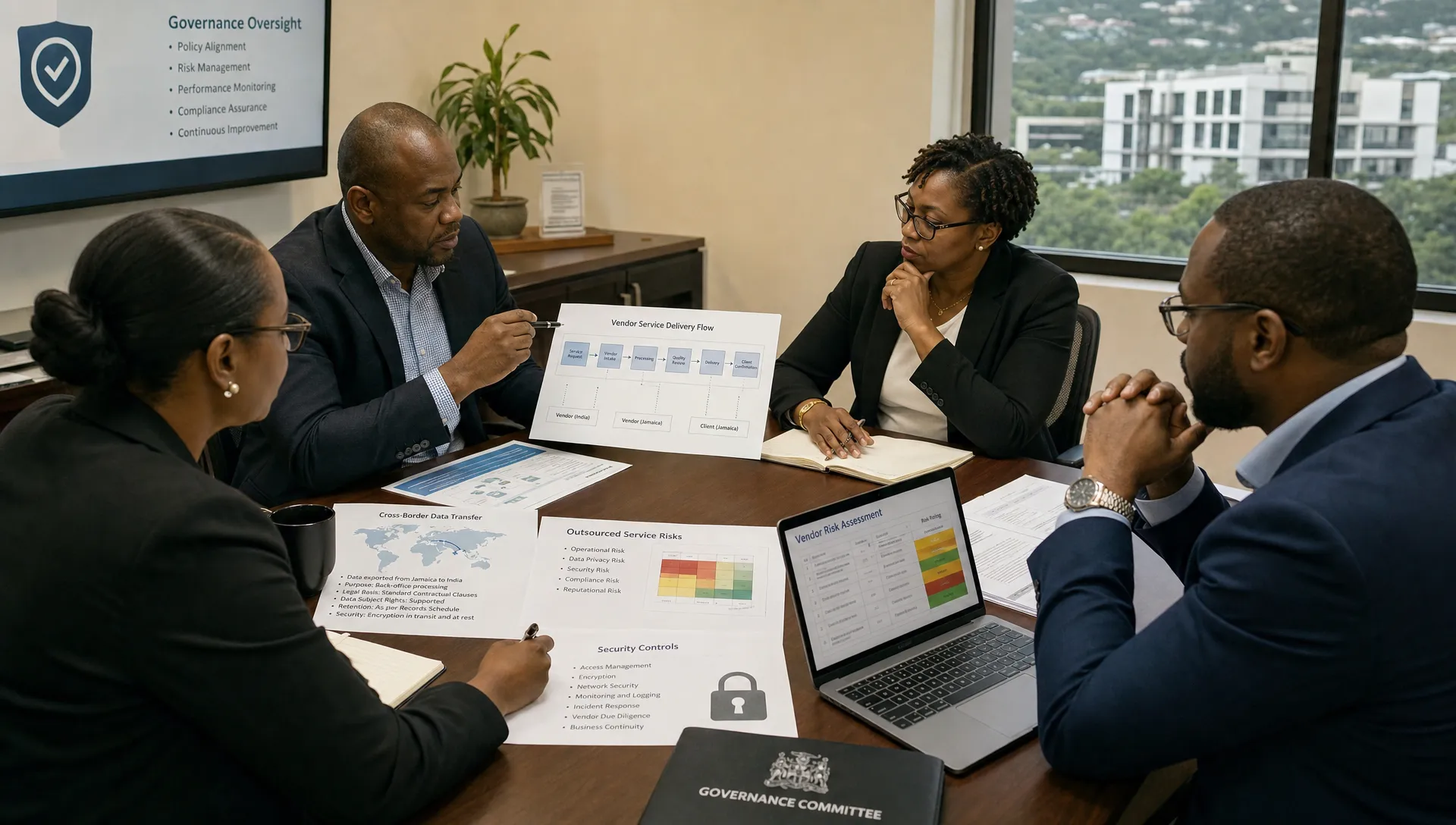
Global outsourcing often means personal data is stored in one country, accessed from another and supported by teams in several time zones. Even when the contract is signed with one vendor, the operational reality may involve remote access, regional backups, offshore support desks and cloud-based collaboration tools.
Cross-border transfers require more than a general statement that data may be processed overseas. The organisation should understand the countries involved, the categories of personal data transferred, the legal basis for transfer, security measures in place and whether individuals have been given appropriate privacy information. Contractual safeguards should also address onward transfers, cooperation with regulatory enquiries and the vendor's duty to notify the client before changing locations where possible.
This issue is especially important for Jamaican businesses serving overseas clients. A client may expect privacy controls aligned with international standards, even where Jamaican law is the primary local compliance driver. Organisations negotiating overseas work may benefit from reviewing practical privacy clauses for contracts with overseas clients before the deal is finalised.
Risk 4: hidden subcontractors and tool chains
A vendor is rarely operating alone. A customer support provider may use a ticketing platform, call recording software, workforce management tool and analytics dashboard. A payroll provider may use hosting services, document storage and tax reporting software. A marketing agency may use enrichment databases, email platforms and automation tools.
Each additional party can increase the attack surface and complicate accountability. The organisation may believe it has approved one provider, but personal data may be accessible to several subcontractors or technology platforms. Some may be located overseas. Some may use the data for diagnostics, product improvement or analytics unless the contract prevents it.
The solution is to require subcontractor transparency. Vendors should disclose relevant sub-processors, obtain approval before material changes and flow down privacy and security obligations to their own suppliers. The organisation should also ask whether any artificial intelligence or automated analysis is used in service delivery, especially where recordings, transcripts, behavioural data or customer profiles are involved.
Risk 5: weak security, breach response and exit controls
Outsourcing privacy risk is closely tied to cyber security, but security alone is not enough. A provider may have reasonable access controls yet still fail to notify incidents quickly, retain data longer than necessary or return records in a format that is unusable when the contract ends.
Incident response should be agreed before the first file is shared. The contract and operating procedure should state how quickly the vendor must notify the client, what information must be provided, who investigates, who communicates with affected individuals and how evidence will be preserved. Timelines should support the client's own legal and regulatory obligations.
Exit planning is just as important. At termination, personal data should be returned, deleted or securely transferred according to documented instructions. Backups, archived tickets, call recordings and test environments should not be forgotten. A weak exit can leave personal data scattered across systems long after the business relationship has ended.
How to reduce privacy risk before outsourcing
The best time to manage outsourcing privacy risk is before procurement becomes urgent. If the business has already selected a vendor and promised a launch date, privacy review may feel like a delay rather than a safeguard. A simple, risk-based process avoids that problem.
Start by mapping the service. Identify what personal data will be shared, whose data it is, why the vendor needs it, where it will be accessed from and whether sensitive or confidential records are included. Then classify the vendor's risk level. A stationery supplier does not need the same review as a payroll processor or outsourced customer support centre.
Control area | What to confirm before signing |
Purpose and scope | The vendor only processes data needed for the service |
Data location | Countries of storage, access, backup and support are known |
Security | Access controls, encryption, logging and staff confidentiality are adequate |
Subcontracting | Sub-processors are disclosed and controlled |
Data subject rights | The vendor must assist within agreed timelines |
Incident response | Notification, investigation and evidence duties are clear |
Exit | Return, deletion and certification steps are documented |
For many organisations, a full audit is not necessary for every provider. A structured questionnaire, document review and risk rating may be enough for moderate-risk services. Higher-risk vendors should face deeper review, including contract negotiation and evidence of controls. PLMC's guidance on how to run a simple vendor privacy assessment is a practical starting point for this kind of approach.
Ongoing oversight matters after onboarding
Vendor privacy management does not end when the contract is signed. Outsourced services change over time. The vendor may add new tools, move support to another country, automate a manual step or introduce a subcontractor. The business may also expand the scope of work and start sharing new categories of personal data.
A workable oversight model should include periodic reviews, updated contact points, evidence of training, incident reporting tests and checks against agreed retention periods. The business owner should remain involved because privacy controls must match the way the service actually operates. Legal and compliance teams can design the framework, but the team managing the vendor sees day-to-day changes first.
Organisations should also train internal staff not to overshare data with vendors. Many privacy issues begin when employees send full spreadsheets, identification documents or customer histories because it is convenient. Data minimisation should be built into templates, portals and approval processes so the vendor receives only what it needs.
Frequently Asked Questions
Does outsourcing transfer data protection responsibility to the vendor? No. A vendor may have contractual and legal obligations, but the organisation that selected the vendor usually retains important accountability for how personal data is used, shared and protected.
What outsourced services create the highest privacy risk? Higher-risk services usually include payroll, HR administration, customer support, IT managed services, marketing databases, lead generation, finance processing, health-related services and any arrangement involving sensitive data or overseas access.
Should Jamaican organisations treat overseas vendors differently from local vendors? The same governance principles apply, but overseas vendors add questions about cross-border transfers, foreign laws, subcontractors, data access locations and whether contractual safeguards are strong enough for the risk.
How often should outsourced providers be reviewed? Review frequency should match risk. Critical or high-risk vendors may need annual reviews, contract refreshes and periodic evidence checks. Lower-risk vendors may only need review at renewal or when the service scope changes.
Can training reduce outsourcing privacy risk? Yes. Training helps business owners, procurement teams and vendor managers recognise when personal data is involved, ask better questions and avoid sharing more information than necessary.
Strengthen outsourced services before privacy issues arise
Outsourcing can support growth, resilience and efficiency, but only when governance keeps pace with the service model. Jamaican organisations should treat vendor privacy management as part of corporate governance, risk management and compliance, not as a final legal checkbox.
Privacy & Legal Management Consultants Ltd. supports organisations with data protection implementation, privacy awareness, risk assessment, cyber security alignment, corporate governance and GRC integration. If your organisation is outsourcing services locally or internationally, a structured privacy review can help you reduce exposure before personal data leaves your direct control.