
Data Protection Specialists vs General Compliance Consultants
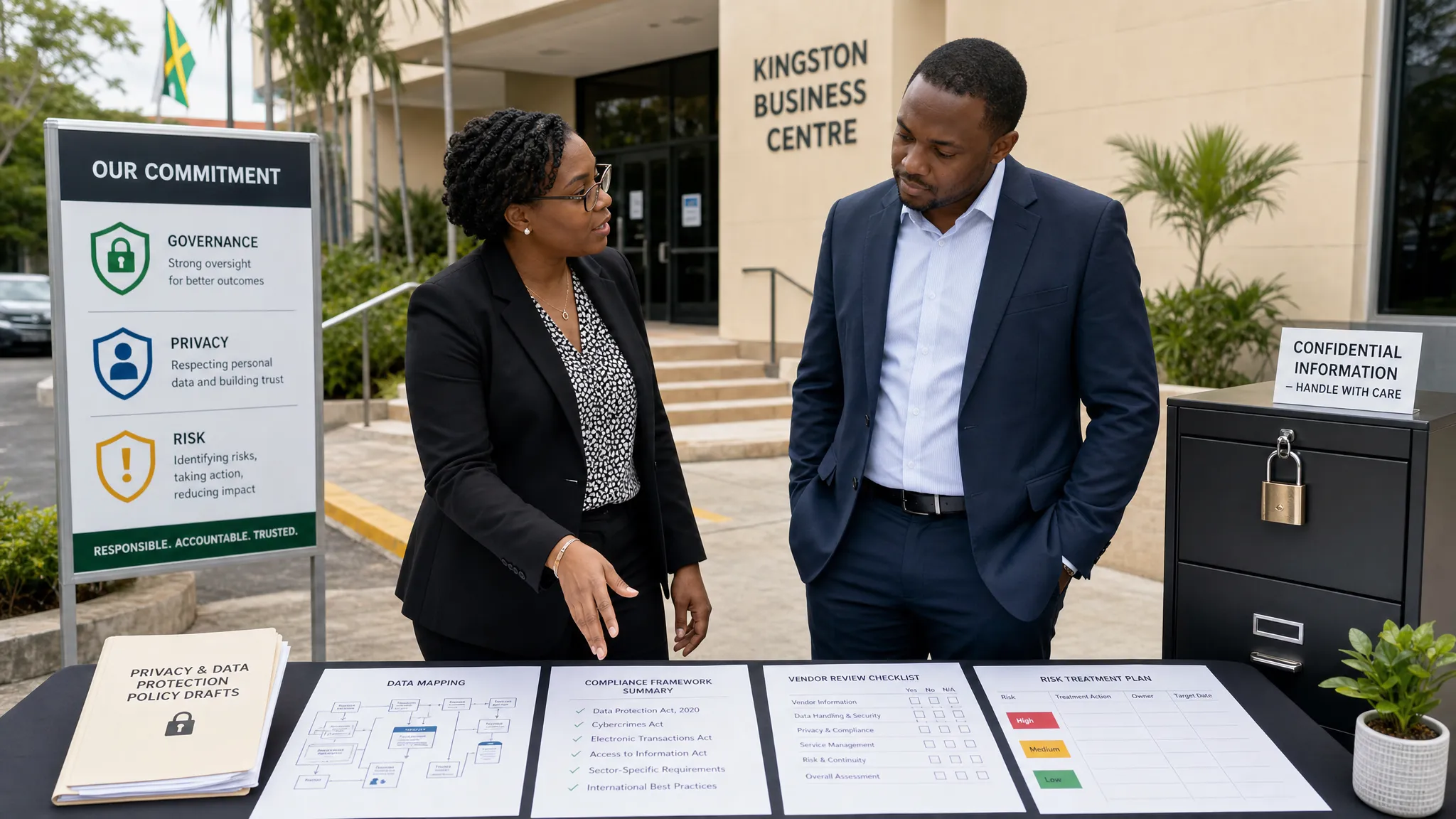
Not every compliance problem is a privacy problem, but every privacy problem has compliance consequences. That is why the choice between data protection specialists and general compliance consultants matters so much for Jamaican organisations.
A general compliance consultant may help you strengthen governance, policies, risk registers, anti-money laundering controls, audit readiness, and board reporting. A data protection specialist goes deeper into how your organisation collects, uses, shares, stores, protects, and deletes personal data under the Data Protection Act 2020.
Both roles can be valuable. The mistake is assuming they are interchangeable.
Why the distinction matters in Jamaica
Jamaica’s Data Protection Act 2020 places practical obligations on organisations that handle personal data. The Act is not only about having a privacy policy on a website. It touches consent, lawful processing, transparency, security safeguards, data subject rights, vendor oversight, breach readiness, retention, and accountability.
The Office of the Information Commissioner is the local regulator responsible for promoting and overseeing compliance. For businesses, charities, schools, financial institutions, health providers, professional services firms, and public bodies, this means privacy compliance must be operational. It must show up in contracts, forms, systems, staff training, internal approvals, incident response, and record keeping.
A broad governance, risk, and compliance programme can support this. But when personal data is central to the risk, specialist privacy knowledge becomes essential.
The core difference: breadth versus depth
The simplest way to compare the two roles is this: general compliance consultants bring breadth across multiple regulatory and governance areas, while data protection specialists bring depth in privacy, data protection, and personal data lifecycle controls.
Area | Data protection specialist | General compliance consultant |
Primary focus | Personal data, privacy risk, and Data Protection Act compliance | Wider governance, risk, compliance, policies, audits, and controls |
Typical questions | What personal data do we process, why, where, for how long, and with what safeguards? | What regulations apply, what policies exist, and how are risks monitored? |
Key outputs | Data maps, privacy notices, DPIAs, processor clauses, retention schedules, DSAR procedures, training | Compliance frameworks, risk registers, governance reports, policy reviews, internal control plans |
Best fit | High-risk processing, sensitive data, new technology, vendor data sharing, data subject rights | Organisation-wide compliance maturity, board reporting, AML, internal governance, audit readiness |
Main risk if used alone | Privacy work may not be embedded into wider GRC structures | Privacy obligations may be treated too generally or missed entirely |
This does not mean one is “better” in every situation. It means each has a different function. The right choice depends on the risk, the maturity of your organisation, and the type of compliance problem you are trying to solve.
What data protection specialists are designed to handle
A data protection specialist focuses on the lawful, fair, transparent, and secure handling of personal data. In Jamaica, that means helping an organisation translate the Data Protection Act 2020 into operational steps that staff can actually follow.
Their work often starts by identifying what personal data exists across the organisation. This includes customer data, employee records, supplier contacts, visitor logs, CCTV footage, health information, financial information, student records, client files, website forms, marketing lists, and data held by third-party service providers.
From there, the specialist helps answer important questions. Why is this data collected? What legal basis or justification supports the processing? Who has access? Is the data shared locally or overseas? How long is it kept? Is it protected appropriately? Can the organisation respond if an individual asks to access, correct, or erase their information where applicable?
A data protection specialist typically helps with:
Data inventory and data mapping across departments, systems, and vendors
Privacy notices, consent language, and transparency documents
Data Protection Impact Assessments for higher-risk activities
Data subject access request procedures and response workflows
Personal data breach preparation and escalation processes
Vendor and processor review, including contract clauses and due diligence
Retention schedules and disposal procedures
Privacy training for staff, managers, and frontline teams
For a deeper view of this specialist role, PLMC has also explained what data protection specialists actually do for your business in the context of Jamaica’s privacy obligations.
The value of the specialist is not just legal interpretation. It is the ability to spot privacy risk in everyday operations. A new customer onboarding form, a WhatsApp group used for work, a cloud-based HR platform, a marketing campaign, or a biometric access system can all create data protection issues that a generic compliance review may not examine in enough detail.
What general compliance consultants are designed to handle
General compliance consultants usually work across a wider field. Their role may include corporate governance, internal policies, risk management, regulatory compliance, anti-money laundering controls, ethics programmes, board reporting, audit preparation, and enterprise-wide control frameworks.
This breadth is useful, especially for organisations that need structure. A company may know it has compliance obligations but lack a central risk register, policy approval process, staff accountability matrix, reporting rhythm, or monitoring system. In that situation, a general compliance consultant can create the framework that allows privacy, AML, cyber security, health and safety, procurement, and other obligations to be managed consistently.
A strong general consultant can help leadership see compliance as part of governance rather than a set of isolated tasks. That matters because privacy compliance often fails when it sits in a silo. If data protection is not connected to procurement, IT, HR, legal, operations, and executive oversight, the programme may look good on paper but remain weak in practice.
However, a generalist may not have the technical privacy depth required to assess a complex data sharing arrangement, review a high-risk technology project, design a data subject request workflow, or determine whether a privacy notice properly reflects actual processing.
When a data protection specialist should lead
A data protection specialist should usually lead when the main risk involves personal data. This is especially true when the organisation handles sensitive or high-volume information, uses new technology, relies on multiple vendors, or shares data across borders.
You should strongly consider specialist support if your organisation is:
Processing health, financial, biometric, children’s, employee, or other sensitive personal information
Introducing new software, AI tools, surveillance tools, cloud platforms, or digital customer portals
Sharing personal data with processors, affiliates, overseas partners, or outsourced service providers
Receiving complaints or requests from individuals about access, correction, consent, or misuse
Preparing for a privacy audit, board review, regulator engagement, or breach response exercise
Building a privacy programme for the first time under Jamaica’s Data Protection Act 2020
High-risk projects deserve special attention because privacy problems become harder and more expensive to fix after systems are already built. If your project involves sensitive data, new technology, vendors, or cross-border processing, this guide on when to hire data protection specialists for a high-risk project may help you assess the timing.
When a general compliance consultant may be enough
A general compliance consultant may be the right starting point when your organisation’s main challenge is governance structure rather than a specific privacy risk. For example, you may need to formalise board oversight, update internal policies, build a risk register, strengthen AML procedures, document internal controls, or prepare for an audit.
A general consultant can also help smaller organisations that are still building basic compliance discipline. If the business has no policy management process, no assigned risk owners, and no consistent reporting, privacy work may struggle to gain traction until the broader governance foundation is in place.
That said, even when a general consultant leads the overall project, privacy-specific deliverables should be reviewed by someone with data protection expertise. This is particularly important for privacy notices, data mapping, vendor processing terms, breach procedures, and staff training content.
The strongest model is often a combined approach
For many Jamaican organisations, the best answer is not “specialist or generalist.” It is both, working in the right order and with clear responsibilities.
A general compliance consultant can help create the governance architecture. A data protection specialist can then ensure the privacy programme is legally sound, risk-based, and operational. Together, they can connect privacy controls to the wider GRC environment so the organisation is not running separate, disconnected compliance projects.
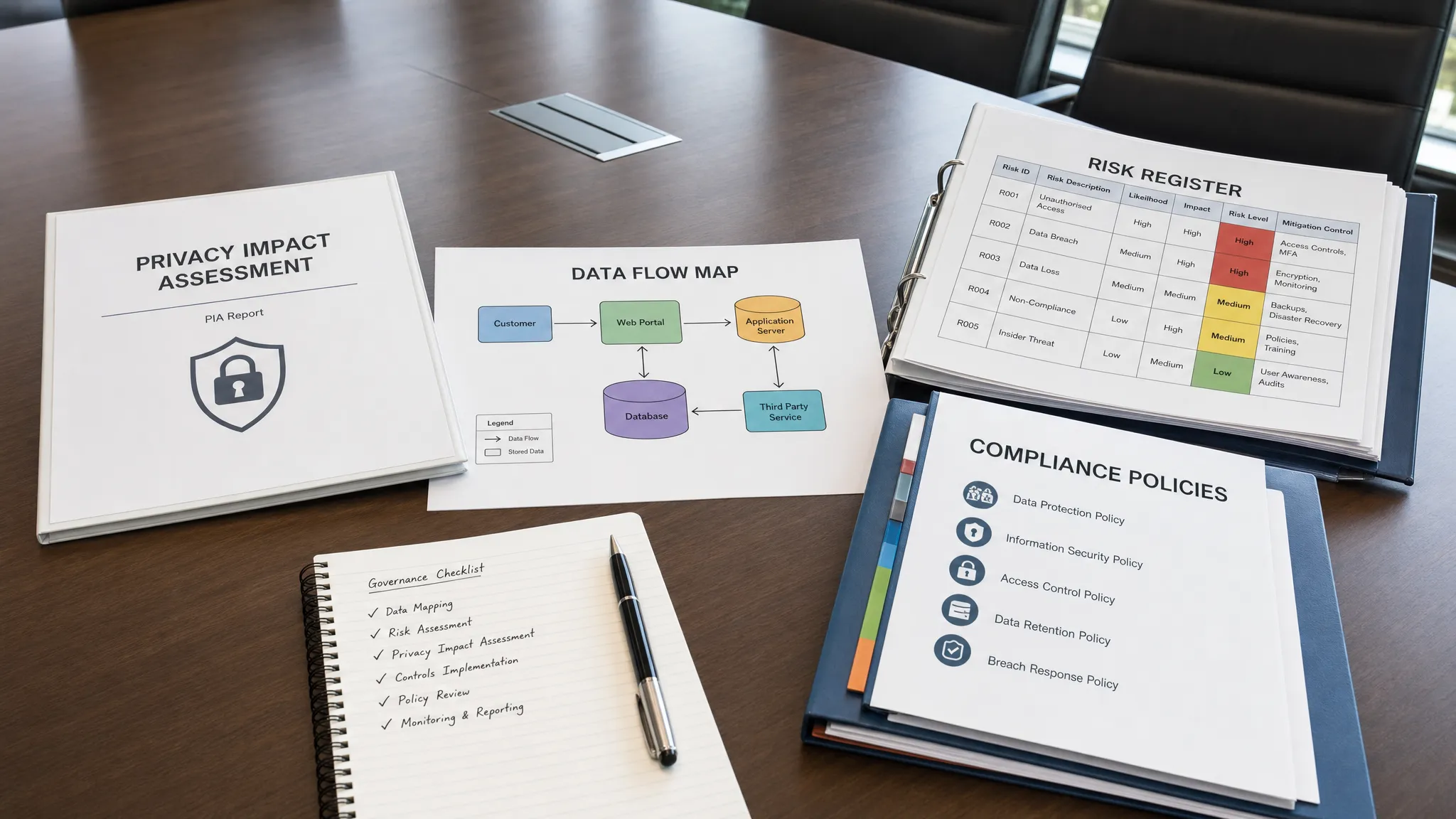
This combined model is especially useful for organisations that manage several compliance duties at once. A financial services business, for example, may need AML controls, cyber security safeguards, privacy compliance, board reporting, staff training, and vendor due diligence. A school may need student privacy practices, HR records controls, safeguarding policies, cyber awareness, and governance oversight. A healthcare provider may need strict patient confidentiality, secure systems, retention rules, consent practices, and incident response.
In each case, privacy must fit into the wider governance system, but it cannot be reduced to a generic compliance checklist.
A practical decision framework
Use the following framework to decide who should lead your engagement.
Your situation | Better lead | Why |
You need a full governance framework, risk register, and policy structure | General compliance consultant | The main need is organisation-wide compliance architecture |
You need to comply with the Data Protection Act 2020 | Data protection specialist | The main need is privacy interpretation and implementation |
You are launching a new system that collects personal data | Data protection specialist | Privacy by design and impact assessment are needed early |
You are preparing board-level compliance reporting across several areas | General compliance consultant | The main need is integrated oversight and reporting |
You are reviewing vendors that process customer or employee data | Data protection specialist | Processor risk, contracts, transfers, and safeguards require privacy depth |
You are improving AML, corporate governance, and privacy together | Combined team | The work needs both broad GRC alignment and specialist privacy controls |
The more personal data risk involved, the stronger the case for a data protection specialist. The more organisation-wide governance maturity is lacking, the stronger the case for a general compliance consultant. If both are true, use both.
The risk of choosing by title or price alone
Many organisations choose consultants based on broad titles, familiar relationships, or lower cost. That can be risky. “Compliance” is a large field, and expertise in one area does not automatically transfer to another.
For example, a consultant with strong AML experience may understand customer due diligence, monitoring, reporting, and regulatory controls. Those skills are valuable. But data protection also requires understanding purpose limitation, minimisation, transparency, retention, data subject rights, processor oversight, and privacy impact assessment. The overlap is real, but it is not complete.
Similarly, a cyber security consultant may be excellent at technical safeguards, access controls, threat management, and incident detection. But data security and data protection are not identical. Security protects systems and information from unauthorised access or loss. Data protection also asks whether the organisation should be processing the data in the first place, whether individuals were informed, whether the use is lawful, and whether the data is kept longer than necessary.
This is why procurement should look beyond credentials and ask what evidence the consultant can produce.
How to evaluate the right consultant
Before engaging either type of consultant, ask practical questions about experience, outputs, and fit. The goal is not to collect impressive language. The goal is to confirm that the consultant can help you produce defensible evidence of compliance.
Strong questions include:
Can you explain how your work applies to Jamaica’s Data Protection Act 2020?
What deliverables will we receive, and how will they be used by our staff?
How will you identify personal data across departments and third parties?
Will you review our actual forms, systems, contracts, and workflows, or only provide template policies?
How will you help us prioritise risks based on impact and likelihood?
Can you train staff in a way that reflects our sector and daily operations?
How will privacy controls connect to our wider governance, cyber security, AML, or risk programme?
If you are preparing to engage a privacy professional, PLMC’s guide on questions to ask before you engage data protection specialists provides a useful starting point.
One important caution: GDPR experience can be helpful, particularly for organisations that process EU personal data or work with international partners. But GDPR knowledge should not be treated as a substitute for local understanding. Jamaican organisations need advice that reflects Jamaica’s legal framework, regulator expectations, business environment, and operational realities.
What good support should produce
Whether you hire a specialist, a generalist, or a combined team, the engagement should leave your organisation stronger than before. A good consultant should not only explain obligations. They should help you create repeatable practices.
By the end of a meaningful engagement, leadership should be able to see what personal data is held, where the highest risks sit, who owns key actions, what policies and procedures apply, what training has been delivered, which vendors need attention, and what evidence exists if a regulator, board member, auditor, client, or data subject asks questions.
That evidence matters. In modern compliance, saying “we take privacy seriously” is not enough. Organisations need records, decisions, approvals, training logs, assessments, contracts, and monitoring activities that show privacy and governance are being managed responsibly.
Frequently Asked Questions
Is a data protection specialist always better than a general compliance consultant? No. A data protection specialist is better when the main issue involves personal data and privacy obligations. A general compliance consultant may be better when the main issue is broad governance, risk management, AML, or policy structure.
Can a general compliance consultant help with Jamaica’s Data Protection Act 2020? Yes, but only to a point. A general consultant can help embed privacy into governance frameworks, reporting, and controls. For detailed privacy work such as data mapping, DPIAs, privacy notices, vendor processing terms, and data subject rights procedures, specialist input is usually safer.
Does GDPR experience matter for Jamaican organisations? It can help, especially for organisations with international operations or EU-related processing. However, GDPR templates should not be copied without review. Jamaica data privacy compliance must reflect the Data Protection Act 2020 and local operational context.
Should small businesses hire data protection specialists? Many small businesses do not need a large or complex privacy project, but they still need practical compliance steps. A specialist can right-size the work by focusing on the personal data the business actually collects, the risks it faces, and the evidence it needs.
What is the biggest warning sign when hiring a consultant? A major warning sign is a template-only approach. If the consultant does not ask how your organisation collects, uses, shares, stores, and deletes personal data, the advice may be too generic to support real compliance.
Build the right compliance team for your risk
The choice between data protection specialists and general compliance consultants should be based on risk, not job titles. If your challenge is personal data, privacy rights, vendor processing, or Data Protection Act compliance, specialist depth matters. If your challenge is wider governance and risk structure, general compliance expertise matters. If your organisation needs both, the strongest approach is an integrated one.
Privacy & Legal Management Consultants Ltd. supports Jamaican organisations with data protection implementation, governance, risk, compliance, anti-money laundering, cyber security, training, and practical privacy awareness. If you are unsure which type of support your organisation needs, a focused consultation can help you clarify the risks, priorities, and next steps.