

Data Laws Jamaican Organisations Should Be Tracking in 2026
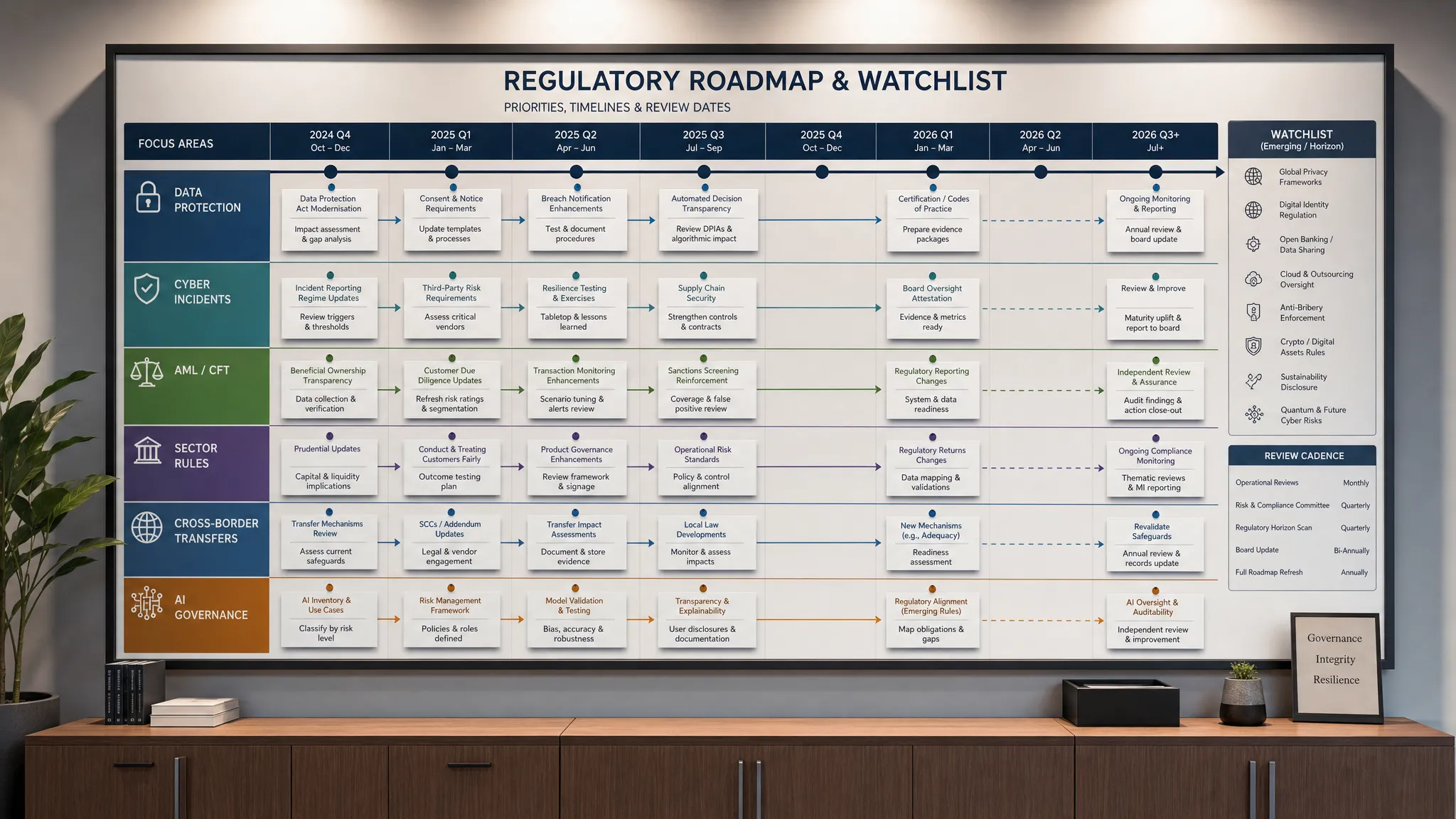
For many Jamaican organisations, 2026 is no longer the year to ask whether privacy compliance matters. The practical question is whether leadership has a living view of the data laws, sector rules, regulator expectations and contract obligations that shape how personal and confidential information is collected, used, stored, shared and deleted.
Jamaica’s Data Protection Act, 2020 remains the centrepiece. But it is not the only rule that affects data. Cybercrime laws, anti-money laundering obligations, sector regulation, public records duties, electronic transaction rules, overseas privacy laws and emerging AI expectations can all change what an organisation must do in practice.
This guide is written for boards, executives, compliance teams, legal teams, IT leaders and privacy officers that need a practical 2026 watchlist. It is general guidance, not legal advice, but it can help you decide what to monitor, who should own each area and what evidence your organisation should be building.
Why data-law tracking matters in 2026
Data compliance is becoming more operational. Regulators, customers, business partners and auditors are less interested in whether an organisation has a policy saved somewhere. They want to know whether the organisation can prove how personal data is handled in real workflows.
That matters because Jamaican organisations are using more cloud platforms, payment tools, HR systems, customer databases, outsourced service providers, AI features and cross-border support models. Each of those choices may create new legal, security, contractual or reputational exposure.
A good data-law tracking process helps an organisation answer four questions:
Which rules apply to the personal data we hold?
Which upcoming changes or regulator expectations could affect our controls?
Which teams need to change their procedures, contracts, notices or training?
What evidence can we show if a regulator, client, auditor or board member asks?
The goal is not to turn every manager into a lawyer. The goal is to make sure legal and compliance changes are translated into practical action.
What should be on the 2026 data-law watchlist?
The phrase data laws should be read broadly. Some laws directly regulate privacy. Others affect identity checks, security, recordkeeping, marketing, financial crime, public access, electronic records, children’s information or cross-border transfers.
Area to track | Why it matters in 2026 | Practical action |
Jamaica Data Protection Act, 2020 | Sets the main standards for lawful, fair, secure and accountable processing of personal data | Maintain a data inventory, privacy notices, rights procedures, vendor controls and evidence of compliance |
Cybercrime and cybersecurity rules | Cyber incidents often create privacy, operational and reporting issues | Strengthen access controls, logging, backups, incident response and breach triage |
AML, KYC and financial crime obligations | Organisations may need to collect and retain identity and transaction data for legal reasons | Align AML records with privacy notices, access limits, retention rules and secure disposal |
Sector regulation | Finance, health, education, telecommunications and public sector entities may face additional duties | Track sector regulator guidance and map it to policies, contracts and training |
Public records and access laws | Public authorities must balance transparency with privacy and confidentiality | Review disclosure procedures, redaction practices and records retention |
Electronic transactions and digital identity | Digital signatures, online onboarding and identity systems affect evidence, consent and verification | Review authentication, audit trails, notices and vendor arrangements |
Overseas privacy laws | Jamaican organisations may serve foreign individuals or process data for overseas clients | Map locations of data subjects, vendors and hosting, then review contract and transfer terms |
AI, analytics and biometrics | New tools may process personal data in less visible ways | Assess purpose, fairness, transparency, security, human review and vendor claims |
1. Jamaica’s Data Protection Act, 2020 and regulator expectations
The Data Protection Act is still the first law most Jamaican organisations should prioritise. It applies broadly to the processing of personal data and requires organisations to think about fairness, lawful purpose, transparency, data minimisation, accuracy, storage limits, security and accountability.
By 2026, a mature programme should be able to show evidence that the Act has been implemented. That means more than having a privacy notice on a website. Organisations should be able to show how they know what personal data they hold, why they hold it, who can access it, which vendors receive it, how long it is retained and how individuals can exercise their rights.
Key 2026 actions include:
Refreshing the data inventory so it reflects current systems, cloud tools, manual files and third-party sharing.
Reviewing privacy notices for customers, employees, vendors, website users and other individuals.
Testing the procedure for access, correction, objection and deletion requests.
Reviewing vendor contracts and processor arrangements, especially for cloud and outsourced services.
Updating retention schedules and secure disposal practices.
Training staff on practical handling rules, not just legal definitions.
Reporting meaningful privacy metrics to management or the board.
If your organisation needs a structured implementation sequence, PLMC’s Data Protection Jamaica compliance roadmap for 2026 is a useful next step.
2. Cybercrime, cybersecurity and incident response obligations
Cybersecurity is not separate from data protection. A compromised email account, ransomware attack, stolen laptop, exposed database or misdirected file transfer can quickly become a privacy incident.
Jamaican organisations should track cybercrime legislation, law enforcement developments, sector cybersecurity expectations and client security requirements. The practical focus should be on readiness. If an incident happens, the organisation must be able to investigate quickly, preserve evidence, contain harm, assess whether personal data was affected and decide who must be informed.
Cyber risk | Data-law concern | 2026 control priority |
Phishing and mailbox compromise | Unauthorised access to customer, HR or financial data | Multifactor authentication, staff training, email filtering and rapid account lockout |
Ransomware | Loss of availability, confidentiality and business continuity | Tested backups, endpoint protection, network segmentation and incident runbooks |
Lost devices | Exposure of files, emails or system access | Encryption, device management, remote wipe and clear reporting procedures |
Weak logging | Inability to prove what happened during an incident | Centralised logs, monitoring, access reviews and escalation triggers |
Vendor breach | Third-party exposure of data controlled by your organisation | Contract clauses, due diligence, incident notification terms and vendor testing |
Boards should ask whether cyber incident response and privacy incident response are connected. In many organisations, IT knows how to contain a technical event, but Legal, Compliance, HR, Communications and senior management are not always integrated into the decision process. That gap can create delay and inconsistent messaging.
3. AML, KYC and financial crime data
Anti-money laundering and counter-terrorism financing obligations are major data drivers for banks, financial institutions, designated non-financial businesses and professions, and other regulated entities. Customer due diligence, source-of-funds checks, transaction monitoring, sanctions screening and suspicious transaction reporting all involve sensitive identity and financial information.
The compliance challenge is balance. AML laws may require collection and retention of certain records, while data protection law requires fairness, purpose limitation, security and storage control. The answer is not to collect everything forever. The answer is to document why specific data is required, restrict access, secure it properly, apply the correct retention rule and dispose of it when the legal and business need ends.
In 2026, organisations subject to AML duties should review whether their privacy notices clearly explain legally required checks. They should also confirm that AML files are not casually accessible across the business. KYC documents, beneficial ownership information and suspicious activity records should be handled on a need-to-know basis, with strong audit trails and staff training.
This is especially important where AML, cyber security and privacy teams operate separately. A good GRC model connects them so that financial crime compliance does not create avoidable privacy risk.
4. Sector-specific laws that affect personal data
Some of the most important data rules are sector-specific. They may come from legislation, regulator guidance, licence conditions, professional standards, contracts or public-sector obligations. In 2026, organisations should treat sector rules as part of their data compliance environment, not as a separate issue.
Finance, insurance, payments and fintech
Financial services organisations should monitor Bank of Jamaica and Financial Services Commission expectations, as applicable, along with outsourcing, operational resilience, cybersecurity, consumer protection and AML requirements. Payment providers and fintechs should pay close attention to identity verification, transaction monitoring, fraud analytics, customer support records and third-party platform integrations.
The key question is whether privacy controls match the risk level of the data. A marketing list and a loan file should not be treated the same way. A payment token, bank account detail or credit decision record may require stronger access controls, shorter internal visibility and more careful vendor due diligence.
Health and wellness providers
Clinics, laboratories, pharmacies, insurers, wellness providers and employers handling medical information should treat health data as high-risk. Patient records, test results, prescriptions, insurance claims, disability information and occupational health records require strong confidentiality and security controls.
Health data also appears outside traditional healthcare settings. HR teams may hold sick leave records. Schools may hold allergy, disability or counselling notes. Gyms and wellness apps may collect health indicators. In 2026, organisations should identify where health-related data appears outside the obvious systems.
Education, youth and family data
Schools, training providers, youth organisations and education technology vendors often process children’s data, parent details, safeguarding notes, academic records, photos, payment data and communications. This information needs careful handling because children and families may not fully understand how data moves across platforms.
Education providers should also think about international collaboration and benchmarking. If a Jamaican school, edtech provider or NGO studies or collaborates with overseas learning models such as personalised school communities in Latin America, it should map what student or family information is exchanged, where it is stored, who can access it and whether parents or guardians have received clear notices.
Public authorities and contractors
Public bodies and organisations providing services to government must balance privacy, transparency, records management and public accountability. Access to information requests, procurement files, citizen service records, complaints, investigations and employee records can all raise data issues.
The practical risk is over-disclosure or under-disclosure. Staff need redaction procedures, escalation routes and a clear understanding of when personal data, confidential business information or legally privileged material should be protected.
5. Cross-border data laws and overseas client requirements
Many Jamaican organisations operate across borders even if they do not think of themselves as international. A tourism business may serve EU, UK, US or Canadian guests. A BPO may process customer information for an overseas client. A professional services firm may use cloud platforms hosted abroad. A school may use foreign learning tools. An online shop may sell to customers outside Jamaica.
Cross-border risk comes from three places. First, Jamaica’s Data Protection Act includes requirements for responsible transfer and handling of personal data. Second, overseas laws may apply depending on where individuals are located, where services are offered or what contracts require. Third, foreign clients may impose privacy and security obligations even where the law does not directly apply.
For 2026, Jamaican organisations should track:
GDPR and UK GDPR exposure where EU or UK individuals, clients or contracts are involved.
US state privacy laws and sector laws where US consumers, patients, students or financial data are involved.
Canadian and Caribbean privacy developments where regional operations or customers are relevant.
Contractual flow-down obligations from multinational clients and technology vendors.
Cross-border transfer clauses, subprocessor lists, support locations and cloud hosting arrangements.
If your organisation serves US customers or processes US data, PLMC’s guide on data privacy in the US for Jamaican firms explains the main areas to watch.
6. AI, analytics, biometrics and automated decision-making
In 2026, AI is one of the biggest reasons data-law tracking needs to be continuous. Even where Jamaica does not yet have a standalone AI statute, existing data protection principles still apply when AI tools process personal data.
Common examples include HR screening tools, customer service chatbots, fraud detection models, credit scoring support, facial recognition, productivity monitoring, learning analytics, marketing segmentation and generative AI tools used by staff.
The risks are not only technical. AI can create privacy and governance concerns if staff upload personal data into unapproved tools, if vendors use customer data to train models, if automated recommendations are treated as final decisions, or if individuals are not told how their data is being used.
Practical 2026 controls should include:
A register of AI and analytics tools that process personal or confidential data.
Rules on which tools staff may use and what data must not be uploaded.
Vendor due diligence that asks about training data, retention, security and sub-processors.
Human review for high-impact decisions affecting employment, credit, education, health or essential services.
Privacy impact assessments for tools that create new risks.
Clear notices where analytics or automated processing materially affects individuals.
Organisations with EU clients should also monitor the EU AI Act because contractual expectations may flow down to Jamaican service providers, especially in technology, BPO, HR, education, finance and regulated services.
7. Retention, records and evidence rules
Retention is where many compliance programmes fail. Data protection law discourages keeping personal data longer than necessary, but other laws may require organisations to keep certain records for tax, employment, AML, corporate, contractual, insurance or litigation reasons.
A defensible retention schedule reconciles these duties. It should state what record type is held, why it is held, which law or business need applies, who owns it, where it is stored, how long it is kept and how it is securely deleted or archived.
Record category | Common conflict | 2026 question to ask |
Customer account records | Service needs, complaints, legal claims and privacy minimisation | Do we keep inactive customer files longer than necessary? |
KYC and AML records | Financial crime duties and restricted access | Are AML files segregated and retained under a documented rule? |
HR records | Employment administration, disputes and employee privacy | Do managers keep duplicate files outside approved systems? |
CCTV footage | Security purpose and over-retention | Is footage deleted on schedule unless needed for an incident? |
Marketing data | Sales goals and consent or objection rights | Can we prove the source, permission status and suppression status? |
Board and company records | Corporate governance and confidentiality | Are sensitive minutes and papers access-controlled? |
Deletion must be planned, not accidental. If staff delete records informally, the organisation may lose evidence it needs. If staff never delete anything, the organisation expands its exposure. The right answer is a controlled retention and disposal programme.
How to track data laws without overwhelming the business
The most effective approach is a simple legal and regulatory watchlist connected to business owners. A long spreadsheet that no one reads will not reduce risk. A short, maintained register with clear owners, review dates and action items will.
Tracking activity | Suggested owner | Evidence to keep |
Legal and regulatory watchlist | Legal, Compliance or Privacy Lead | Register of applicable laws, guidance, dates reviewed and assigned actions |
Sector updates | Relevant business owner with Compliance support | Regulator notices, meeting notes and impact assessments |
Vendor and cloud changes | Procurement, IT and Privacy | Due diligence files, contracts, transfer assessments and subprocessor reviews |
Data inventory updates | Business units with Privacy support | Current processing records, system lists and data flow notes |
Board reporting | Executive sponsor or DPO | Quarterly dashboards, risk ratings, decisions and remediation status |
Training updates | HR, Compliance and department heads | Attendance, assessments, scenario results and refresher schedules |
A practical 90-day approach can work well.
In the first month, establish the watchlist, assign owners and identify the laws and sector rules most relevant to the organisation. In the second month, map those obligations to the highest-risk processing activities, such as HR, customer records, KYC, health data, vendor sharing, cloud hosting and marketing. In the third month, update the priority controls, refresh training and present a concise report to leadership.
The board does not need every legal detail. It needs risk visibility, key decisions and evidence that management is closing gaps.
Board questions Jamaican leaders should ask in 2026
Leaders can use the following questions to test whether data-law tracking is working:
Do we know which data laws and sector rules apply to our organisation?
When was our data inventory last updated, and does it include cloud tools and manual files?
Can we show evidence that privacy notices, contracts and procedures match real practice?
Are cyber incidents and privacy incidents handled through a coordinated process?
Do we know which vendors process personal data and where they store or access it?
Are AML, HR, marketing, CCTV and customer service data covered by retention rules?
Have we reviewed AI tools, analytics systems and staff use of generative AI?
Does the board receive meaningful privacy and data risk metrics at least quarterly?
For a deeper leadership lens, PLMC’s article on privacy legal risks boards should review this quarter can help structure board discussions.
Frequently Asked Questions
Which data law should Jamaican organisations prioritise first? Most organisations should start with Jamaica’s Data Protection Act, 2020 because it provides the main framework for personal data handling. After that, prioritise sector rules, cyber obligations, AML requirements and overseas laws based on your business model and data flows.
Do small businesses need to track data laws in 2026? Yes. The level of formality may differ, but SMEs still need to know what personal data they collect, why they use it, who receives it, how it is secured and how long it is retained. A simple watchlist and evidence folder can be enough to start.
Is cybersecurity compliance separate from data protection compliance? No. Cybersecurity is a key part of protecting personal data, but data protection is broader. It also covers lawful purpose, transparency, minimisation, rights handling, retention, vendor governance and accountability.
When do overseas privacy laws matter to a Jamaican organisation? Overseas laws may matter if you target foreign customers, monitor people abroad, process data for overseas clients, use foreign vendors or accept contracts that impose foreign privacy obligations. The answer depends on your data flows and legal relationships.
Do AI tools create data protection obligations? Yes, if they process personal data. Organisations should assess what data the tool uses, whether individuals are informed, whether the output affects decisions, how long the vendor keeps data and whether the tool creates fairness, security or confidentiality risks.
Need help turning data laws into practical controls?
Tracking data laws is only useful if it leads to action. Privacy & Legal Management Consultants Ltd. helps organisations in Jamaica strengthen data protection implementation, corporate governance, AML compliance, cyber security, GRC integration, training and risk assessment.
If your organisation needs a 2026 readiness review, a privacy programme refresh or role-based staff training, contact Privacy & Legal Management Consultants Ltd. to discuss practical next steps and available consultation support.