

Customer Loyalty Programmes and Data Protection in Jamaica

A customer loyalty programme can turn occasional shoppers into regular customers, but it also creates data protection responsibilities. A Jamaican supermarket, pharmacy, restaurant or online retailer may link names and telephone numbers to purchase histories, rewards balances and marketing preferences. That information needs more careful handling than a simple points counter suggests.
The practical challenge is to deliver the promised rewards without treating membership as permission to collect everything or advertise through every available channel. Good programme design separates what is needed to administer benefits from what the business would like to know for marketing.
When loyalty records become personal data
A loyalty record does not need to include a customer’s full name to qualify as personal data. A membership number, telephone number or app identifier can identify someone when connected with other information held by the business.
For example, a retailer may hold a member’s contact details in its customer database while keeping purchases in a separate point-of-sale system. If those records can be linked, separating the systems does not make the purchase history anonymous.
Loyalty data can also reveal more than customers expect. Repeated purchases may suggest household circumstances, religious practices or health concerns. Not every purchase automatically becomes sensitive personal data, but building profiles around these characteristics introduces additional legal and fairness concerns.
Replacing a name with a membership number is not the same as anonymising the information. Treat linkable transaction histories as personal data throughout their use.
How Jamaica’s data protection rules apply
Jamaica’s Data Protection Act, 2020 provides the legal framework for processing personal data. Its requirements apply to loyalty programmes just as they apply to other customer records. The Office of the Information Commissioner is the official regulatory source for guidance and compliance information.
The Act’s data protection standards address fair and lawful processing, specified purposes, data minimisation, accuracy, retention, individuals’ rights, security and overseas transfers. For a loyalty programme, these translate into practical decisions about registration forms, advertising, access permissions and supplier contracts.
Your business will generally be a data controller where it decides why and how member information is used. A software supplier may act as a processor when handling information on your instructions. However, a supplier using member data for its own advertising or other independent purposes needs a separate assessment of its role.
Buying a loyalty platform does not transfer your compliance responsibilities to its vendor.
Design enrolment around the rewards you actually offer
Start with the programme’s promised benefits, then identify the minimum information needed to provide them. A points scheme does not automatically need an address, date of birth, gender and government-issued identification.
Information requested | A proportionate approach |
Telephone number or email address | Collect the contact detail needed for account access or necessary communications, rather than automatically requiring both. |
Birthday | For a birthday reward, consider whether day and month are sufficient without collecting the year. |
Home address | Request it when needed for delivery or another defined purpose, not simply because the form has a field. |
TRN or identification document | Do not collect routinely for a standard points scheme without a justified need or applicable legal requirement. |
Purchase history | Define which transaction details support points, returns or another explained purpose. Assess profiling separately. |
Make optional fields genuinely optional. If customers cannot finish registration without providing information labelled “optional”, the enrolment process contradicts the notice.
Give a short, accessible privacy explanation at the point of sign-up, with a fuller notice available. Explain who operates the programme, what information is collected, why it is used, relevant sharing, retention and how members can exercise their rights.
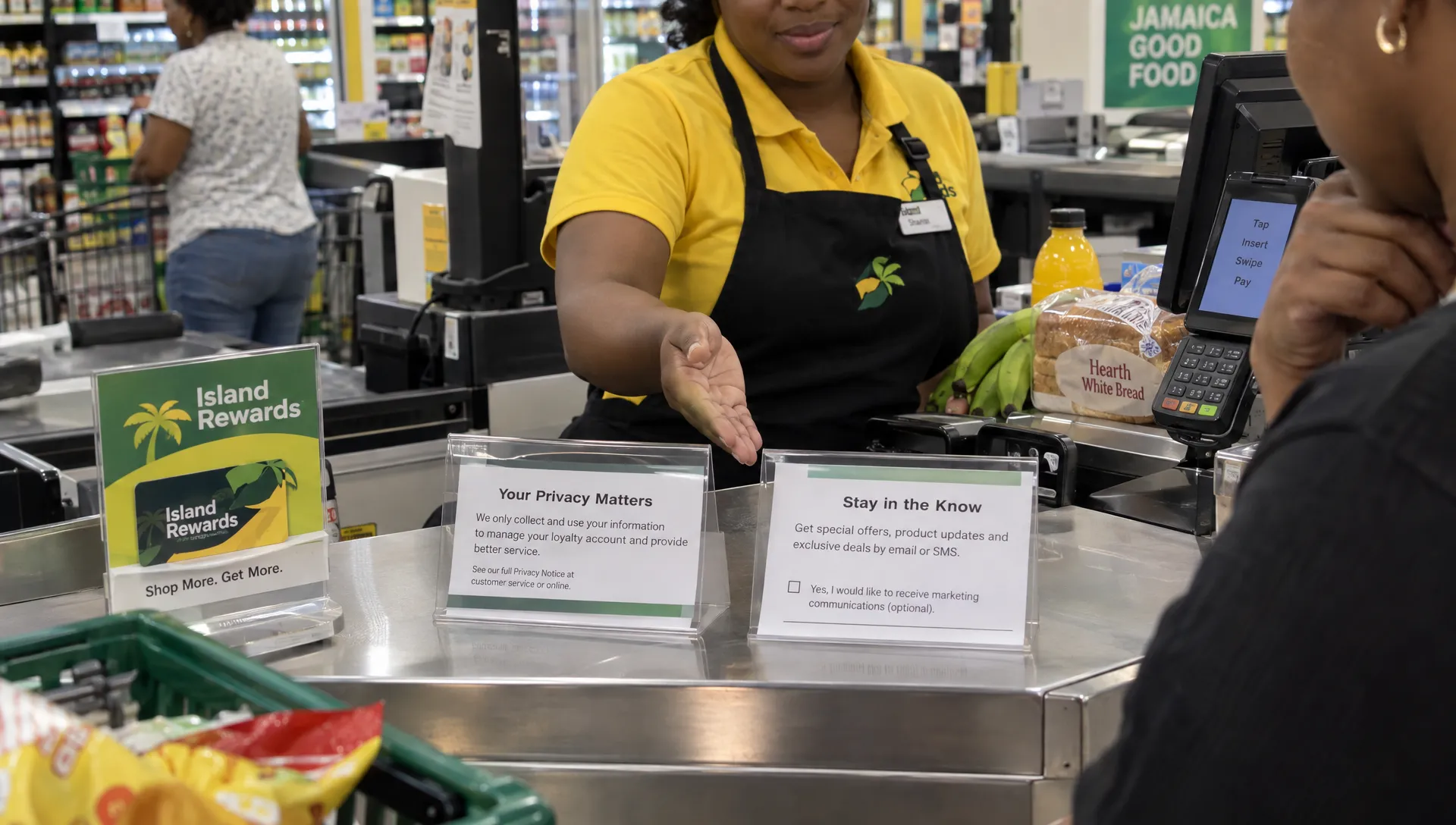
At a busy checkout, staff should be able to explain whether a telephone number is for account identification, promotional messages or both. A privacy notice hidden behind several app screens will not resolve a misleading verbal explanation.
Separate rewards administration from direct marketing
Keeping a points balance and sending a promotional WhatsApp message are different activities. Identify and document the applicable lawful processing condition for each purpose rather than relying on one blanket agreement.
Information genuinely needed to administer membership may require a different legal analysis from optional advertising. Do not assume that consent is the only available condition for every activity, or that accepting programme terms authorises every future use.
For promotional email, SMS and WhatsApp, build around a clear, affirmative opt-in that meets the applicable requirements. Avoid pre-ticked boxes and vague wording such as “I agree to receive communications from selected partners”.
A more specific example, adapted to the programme’s actual practices, is:
Yes, send me promotional offers from [business name] by SMS. I can withdraw this choice at any time using the unsubscribe method provided.
Keep evidence of the customer’s choice, including the date, collection channel and wording shown. Where customers can choose different marketing channels, preserve those choices separately.
Receiving an electronic receipt is not, by itself, a marketing opt-in. Equally, a customer who stops promotional messages should not automatically lose their points or stop receiving necessary account communications. Keep administrative messages focused on administration rather than inserting advertising into them.
Put limits on purchase-history profiling
Personalised offers can be useful, but the purpose should be understandable to the member. Offering a discount on a regularly purchased product is different from inferring a medical condition or selling access to a customer segment.
Before introducing a profiling feature, assess what it infers, whether customers would reasonably expect it and whether a less intrusive approach could achieve the same result. Review any additional requirements where sensitive personal data is involved.
Shared family accounts deserve particular attention. A purchase history visible to every account user can disclose items that one household member expected to keep private. Decide what members can see before enabling shared access, rather than relying on customers to discover the consequences.
Fraud controls also need limits. If an automated rule freezes an account after unusual redemptions, provide a practical route for human review. Obtain legal advice where decisions made solely through automated processing could significantly affect a customer.
For children’s participation, consider age-appropriate explanations, safeguards and applicable consent requirements before allowing detailed tracking or targeted advertising.
Check loyalty vendors, partners and overseas access
Map where information travels. A typical arrangement may involve a point-of-sale provider, cloud platform, messaging service and analytics supplier. Adding a partner reward can introduce another recipient with different purposes.
Ask whether each supplier processes information only on your instructions, uses subcontractors or can reuse member data. Contracts should address permitted processing, confidentiality, security, incident reporting, assistance with rights requests and deletion or return of data when the relationship ends.
Uploading customer lists to an advertising platform for audience matching is another use that needs assessment. It should not be treated as a routine extension of running the rewards account.
Identify hosting locations and access from outside Jamaica, including overseas support teams. Assess the Act’s overseas-transfer requirements rather than assuming that a familiar software brand or Caribbean location makes the arrangement compliant. PLMC’s guidance on managing customer data across Caribbean borders explores the wider transfer issues.
A partner’s participation in the same rewards network does not automatically entitle it to the full membership database.
Protect accounts at checkout and during redemption
Loyalty points have value, so account misuse can harm both customers and the business. Security should cover enrolment, account changes, redemptions and staff access, not just the platform’s login page.
Practical controls include:
Role-based access: Give cashiers the information needed to serve customers without routine access to full purchase histories or database exports.
Proportionate verification: Check account ownership before changing contact details or allowing high-value redemptions, without routinely copying identification documents.
Individual staff accounts: Avoid shared logins that make it difficult to establish who viewed or changed a record.
Account-change alerts: Where appropriate, notify members of sensitive changes without exposing unnecessary information in the message.
Incident procedures: Prepare for unauthorised exports, misdirected offers, compromised accounts and lost paper registration forms.
Staff should avoid reading full telephone numbers aloud or leaving enrolment sheets visible at the till. Publicly visible screens and discarded receipts can undermine otherwise strong technical controls.
Record and assess incidents promptly, including whether regulatory or customer notification is required under the applicable rules. Do not assume that an incident is insignificant simply because no payment-card information was involved.
Plan for inactivity, withdrawal and customer requests
Points expiry and data retention are separate decisions. A balance reaching zero does not necessarily justify deleting every transaction record immediately, but it does not justify keeping a detailed customer profile indefinitely either.
Set retention rules for active accounts, inactive memberships, transaction records, marketing permissions and complaint files. Where records must be retained for another lawful purpose, separate that requirement from continued use for advertising.
Keep only the information needed to honour marketing objections. A minimal suppression record can help prevent a withdrawn contact from being re-added through an old spreadsheet or later import.
Make it practical for members to request access, correct inaccurate details, raise concerns or exercise other applicable rights. Staff should know where to send requests and how to verify identity proportionately. Do not promise automatic deletion of every record where lawful retention obligations or other applicable grounds remain.
These workflows should form part of your data protection policies and procedures, not sit only in the loyalty supplier’s help centre.
Test the programme before launch
Assign an owner who can bring marketing, IT, customer service and compliance together. Then test real customer journeys rather than reviewing documents alone.
Try enrolling without optional information, declining marketing, changing a telephone number, redeeming points, closing an account and making an access request. Check that the website, checkout process and supplier systems preserve the same choices.
Repeat the review when introducing new partners, app permissions or analytics features. A programme that was proportionate at launch can become intrusive as extra data uses accumulate.
Keep a record of the purposes, processing conditions, data fields, recipients and retention decisions. This makes later reviews more reliable than trying to reconstruct why a field or integration was added.
Frequently asked questions
Does joining a loyalty programme mean a customer has agreed to marketing? No. Membership should not be treated as blanket permission for promotional messages. Separate programme administration from marketing and obtain the permissions required for the relevant activity.
Can a Jamaican retailer use an overseas loyalty platform? Potentially, but it must assess the platform’s processing arrangements, security and overseas transfers under Jamaica’s requirements. The supplier’s popularity does not establish compliance.
Can customers withdraw marketing permission and keep their points? Design the programme so that withdrawing optional marketing permission does not automatically cancel earned rewards. Distinguish refusal of optional advertising from information genuinely needed to administer membership.
Are paper loyalty cards outside the Act? Not necessarily. A genuinely anonymous stamp card differs from a card or organised paper record linked to an identifiable customer. The format alone does not determine whether data protection requirements apply.
Review your loyalty programme with PLMC
Before launching or expanding a rewards scheme, review the information collected, marketing choices, profiling and supplier arrangements together. Privacy & Legal Management Consultants Ltd. supports Jamaican organisations with data protection implementation, risk assessment and training. Request a free consultation with PLMC to discuss your programme’s compliance needs.