

Closing Audit Findings Without Relying on Quick Fixes

Closing audit findings should mean that the underlying problem has been addressed and the relevant control works in practice. Too often, however, a finding is marked complete because someone updated a policy, delivered training or submitted a screenshot. Those actions may be necessary, but they do not necessarily demonstrate that the weakness has been resolved.
For Jamaican organisations managing data protection, cyber security and anti-money laundering obligations, premature closure can leave the original exposure intact. It also creates avoidable work when the next audit identifies the same issue.
A stronger approach connects each finding to its cause, assigns accountable ownership and requires evidence proportionate to the risk. The objective is not simply to clear the audit tracker. It is to prevent the problem from recurring.
What closing audit findings should actually mean
Three different activities are often treated as interchangeable: correcting an immediate problem, implementing a lasting solution and verifying that the solution works.
Activity | Purpose | Example involving former employees’ access |
Immediate correction | Address the exposure already identified | Disable accounts that should have been removed |
Corrective action | Fix the process that allowed the exposure | Connect staff departures to an assigned access-removal workflow |
Effectiveness testing | Establish whether the revised process works | Check subsequent departures against account-disablement records |
An action being completed is not the same as a control being effective. A revised procedure proves that a document changed. It does not prove that staff follow the procedure, that every relevant system is covered or that exceptions receive attention.
This distinction matters for privacy documentation too. Including the necessary provisions in a Jamaican privacy policy addresses document content, but operational findings still require evidence that actual practices match those commitments.
Agree on closure criteria before work begins
An audit finding should identify the expected requirement, the observed condition and the resulting risk. Where the cause is not yet established, record it as requiring investigation rather than presenting an assumption as fact.
Before approving an action plan, management and the reviewer should agree on what successful remediation will look like. A useful closure statement explains:
Scope: Which systems, teams, records or locations must be covered.
Required change: What must operate differently after implementation.
Evidence: What records will demonstrate implementation and effectiveness.
Verification: Who will review the evidence and how the assessment will be performed.
Timing: When implementation is due and when meaningful testing can occur.
For a Jamaican data protection finding, identify the applicable legal requirement separately from internal policy or contractual requirements. The Office of the Information Commissioner provides official information on Jamaica’s Data Protection Act, 2020.
An auditor’s recommendation may describe one possible solution. Management should still ensure that the chosen response addresses the actual requirement and risk, rather than merely reproducing the recommendation’s wording.
Find the cause, not just the person who made the mistake
“Human error” is rarely a sufficient root-cause analysis. It describes an event without explaining why the organisation’s controls allowed that event to create an exposure.
Suppose a former employee retains access to a customer database. Disabling the account addresses the immediate problem. The underlying cause might be that HR notifications exclude temporary staff, nobody owns access removal for that application or the organisation has no reliable inventory of accounts.
Each cause requires a different response. Additional training will not resolve an application that has no assigned owner.
Investigate the process using records, walkthroughs and conversations with the people who perform the work. Compare the documented procedure with what actually happens, including exceptions and workarounds. Ask whether the same weakness could affect other departments, contractors or systems.
Where several findings share a common cause, such as unclear ownership, address that cause through a coordinated action plan. This is where a data compliance programme grounded in day-to-day operations can support remediation without creating a separate process for every audit observation.
Build actions around controls, ownership and dependencies
A useful corrective action describes a change in how work is performed, not merely a deliverable.
“Conduct privacy training” is an activity. “Require the relevant team to apply and document the approved disclosure checks before releasing personal data” describes a control. Training may help implement that control, but attendance alone does not demonstrate that the checks are performed correctly.
Assign one accountable action owner with enough authority to coordinate delivery. Other teams can contribute, but shared responsibility should not leave everyone assuming someone else will finish the work.
Record dependencies explicitly. An access-control improvement may rely on HR notifications, application administration and supplier support. If a dependency is unresolved, the plan should show how it affects delivery and what interim protection is in place.
Interim controls can reduce exposure while a permanent solution is developed. A documented manual review may be reasonable, provided its owner, frequency, evidence requirements and limitations are clear. It should not quietly become permanent through repeated deadline extensions.
Build an evidence pack that another person can assess
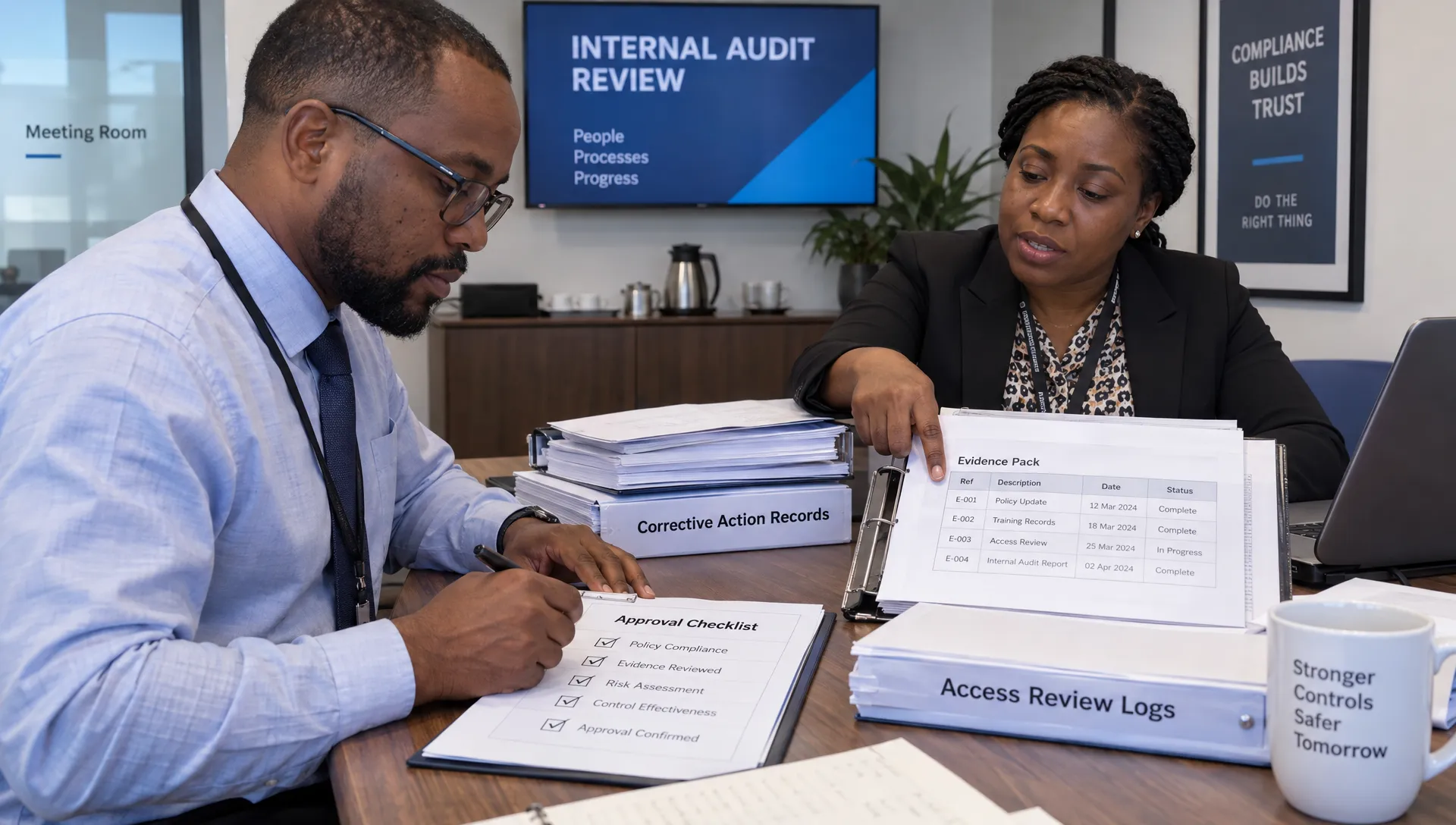
Evidence should allow a reviewer to understand what changed, where it changed and whether it worked. A folder containing many files is not necessarily a persuasive closure pack.
Start with a short explanation linking the original finding to the corrective action. Then distinguish evidence of design, implementation and operation. An approved procedure demonstrates design; a configured workflow demonstrates implementation; completed records demonstrate operation.
For an access-removal finding, useful evidence could include the approved workflow, assigned system owners, departure notifications, account-disablement timestamps and records of exceptions being resolved. The pack should explain which systems and departures were covered, including any exclusions.
Screenshots can support an assessment, but they often show only one configuration at one moment. Where possible, supplement them with logs, transaction records or other evidence that demonstrates the control operating over time.
Audit evidence can itself contain personal or confidential information. Restrict access, avoid unnecessary copies and redact information that the reviewer does not need. Retain evidence under an appropriate retention schedule, taking account of applicable legal and investigation requirements.
Verify effectiveness before granting final closure
Management owns remediation. Internal audit or another suitably independent reviewer should assess whether the evidence supports closure, according to the organisation’s assurance arrangements.
The Institute of Internal Auditors’ Global Internal Audit Standards, particularly Standard 15.2, address confirming implementation of recommendations or action plans through an established methodology that includes risk-based follow-up assessments.
Testing should reflect the nature of the control. A configuration change may be inspected and tested shortly after implementation. A quarterly review cannot demonstrate sustained operation immediately after its procedure is approved.
Select a period and population that give the control a meaningful opportunity to operate. Where sampling is appropriate, document the rationale and include relevant exceptions, rather than selecting only convenient examples. Small populations may justify checking every item.
If testing identifies failures, assess their cause and significance before deciding whether to expand testing, revise the action or keep the finding open. No reported incidents is not, by itself, evidence that a control works. Incidents may be undetected or unreported.
Example: move beyond deleting an exposed file
Consider an illustrative finding: a spreadsheet containing customer information is available through an unrestricted sharing link.
Removing the link is the immediate correction. It does not establish whether other exposed files exist or whether staff can create the same exposure tomorrow. The organisation should also assess whether the event requires separate incident-response action. Remediation does not replace that assessment.
Root-cause analysis might identify permissive sharing settings, unclear approval responsibilities and no review of external links. A corrective action plan could therefore combine safer default settings, an exception approval process and periodic checks of externally shared material.
Closure evidence would show that the settings were applied across the agreed scope, existing links were reviewed and the exception process operated as intended. Testing should include attempts to create unapproved sharing links and examination of approved exceptions.
The finding is not resolved simply because the original spreadsheet is no longer exposed. The closure decision should address the wider weakness that made the exposure possible.
Keep overdue actions and residual risk visible
A remediation tracker should support decisions, not just report completion percentages. It should distinguish work in progress, actions awaiting verification and findings whose closure has been validated.
Track the accountable owner, original and revised deadlines, dependencies, evidence location, testing outcome and remaining risk. Preserve the reason for each deadline change so repeated extensions do not erase the history of delay.
Escalate overdue high-risk actions through the appropriate corporate governance arrangements. Leadership needs to understand the exposure and interim protection, not just receive a new target date.
If management chooses to accept residual risk, record the decision through the authorised process rather than describing the issue as fixed. Risk acceptance does not remove a statutory obligation or establish compliance with it. Where a legal requirement remains unmet, the organisation needs an appropriate compliance response.
Closing audit findings becomes more reliable when reporting separates implementation progress from verified risk reduction.
Frequently asked questions
Can a finding be closed after a policy is updated? Sometimes, if the finding concerns only a documented requirement and the approved update fully addresses it. If the finding concerns operational behaviour, additional evidence is normally needed to show that the revised control has been implemented and works.
How long should remediation take? There is no universal period. Set deadlines according to the exposure, applicable requirements, complexity and dependencies. Distinguish the implementation deadline from the later date when effectiveness can reasonably be assessed.
Can an audit finding be partially closed? Organisations use different status conventions. Where only part of the scope has been remediated, record that progress clearly and keep unresolved exposure visible. Avoid a status that suggests the entire finding has been resolved.
What should happen when the same finding returns? Reassess the original root-cause analysis, scope and verification method. A repeat finding may indicate that the corrective action was too narrow, the control was not sustained or the earlier evidence did not support closure.
Strengthen your approach to remediation
If audit actions repeatedly stall or findings return, review the closure process before adding more tasks to the tracker. Start with one significant finding and check whether its cause, owner, success criteria and evidence requirements are clear.
Privacy & Legal Management Consultants Ltd. supports Jamaican organisations with data protection implementation, corporate governance, cyber security and GRC integration. Arrange a free consultation with PLMC to discuss your organisation’s compliance priorities and the support needed to address them.