

Beneficial Ownership Checks for Jamaican AML Compliance
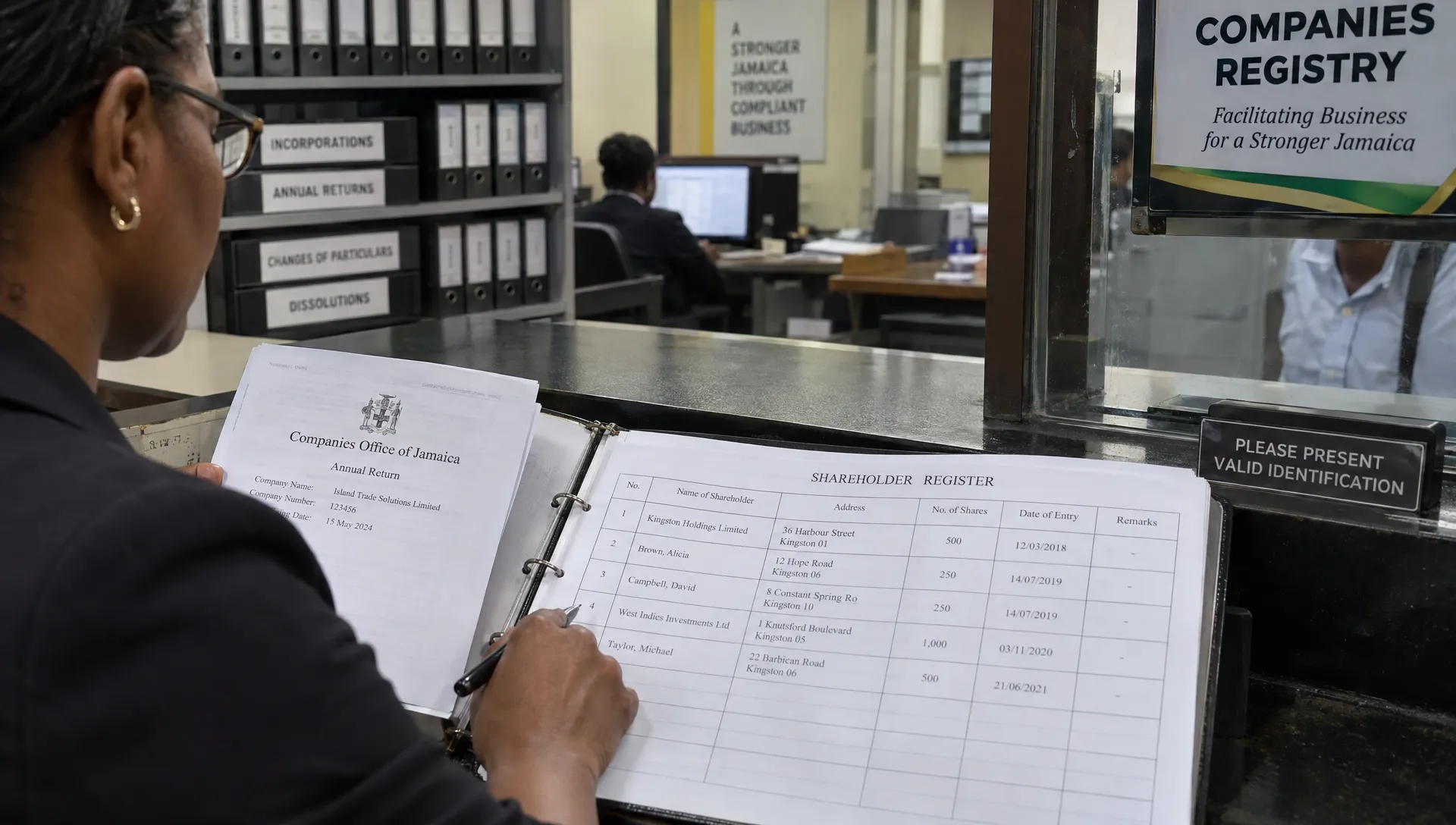
Beneficial ownership checks help Jamaican businesses identify the real people behind corporate customers, rather than stopping at a company name, a director or the person signing an application. For organisations subject to anti-money laundering obligations, the task is to establish who ultimately owns or controls the customer and retain evidence that supports that conclusion.
A signed declaration is a starting point, not the whole process. A defensible review connects the ownership structure, reliable verification evidence and the organisation’s risk assessment. This guide explains how to build that process without treating every complex company as suspicious or collecting personal information without a clear purpose.
What beneficial ownership checks must establish
A beneficial owner is a natural person who ultimately owns or controls a customer, or on whose behalf a transaction is conducted. The exact legal definition and identification requirements must be checked against the Jamaican rules applicable to your organisation.
Three roles can easily be confused:
Role | What it establishes | What it does not establish by itself |
Registered shareholder | Who legally holds shares | Whether that person holds them for someone else |
Director | Who holds a formal management position | Who ultimately owns or controls the company |
Authorised signatory | Who may act for the customer | Who benefits from or ultimately controls the relationship |
A person can occupy several of these roles, but evidence of one role does not prove the others. A nominee shareholder, for example, may appear on company records while holding shares for another person.
The practical objective is to explain which natural persons ultimately own or control the customer, how they do so and what evidence supports the finding. Ownership percentages matter, but voting arrangements, appointment rights and other means of control may also matter.
Start with the Jamaican obligations that apply to your business
For Jamaican AML compliance, relevant requirements may arise under the Proceeds of Crime Act, the Proceeds of Crime (Money Laundering Prevention) Regulations and applicable supervisory guidance. The requirements depend on the organisation, its regulated activities and the circumstances of the relationship.
Financial institutions and designated non-financial businesses should establish which obligations apply before designing their procedures. Being incorporated in Jamaica does not, by itself, mean that every business has the same AML customer due diligence duties.
Keep two processes distinct: a company’s beneficial ownership reporting obligations under the Companies Act framework and an obliged business’s duty to identify and verify its customers’ beneficial owners. Filing information with the Companies Office of Jamaica does not automatically complete a customer’s AML review.
The FATF Recommendations, particularly Recommendations 10, 24 and 25, provide an international reference for customer due diligence and ownership transparency. They do not replace Jamaican legislation. Do not copy an overseas ownership threshold or exemption into your policy without checking its local applicability.
A practical beneficial ownership verification workflow
1. Establish the customer’s legal identity and business purpose
Before tracing individuals, confirm which legal entity you are dealing with. Obtain the information required by your applicable framework, including its legal name, registration number, jurisdiction of incorporation and relevant business addresses.
Check its legal existence against reliable records. The Companies Office of Jamaica is the relevant starting point for Jamaican company information and filing services. For foreign entities, use the appropriate registry or other reliable sources, subject to lawful access and availability.
Understand why the customer needs the proposed product or service. Its business activities, expected transactions and countries of operation provide context for assessing whether the ownership structure makes commercial sense.
Record any differences between the application, registry records and supporting documents. A trading name or recent address change may have an ordinary explanation, but the file should contain that explanation.
2. Trace ownership and control to natural persons
Request an ownership structure showing each corporate layer between the customer and its ultimate owners. Include ownership percentages, relevant voting rights and the jurisdictions in which intermediate entities are established.
Consider this simplified, fictional example:
Person | Ownership route | Calculated economic interest in the customer |
Althea | Owns 50% of a holding company that owns 60% of the customer | 30% |
Martin | Owns the remaining 50% of that holding company | 30% |
Devon | Owns 40% of the customer directly | 40% |
These calculations explain economic ownership. They do not, on their own, determine who must be identified under the applicable legal test. Consider interests held through multiple routes and assess control separately.
Ask about shareholder agreements, nominee arrangements, rights to appoint or remove directors and other arrangements that may give someone effective control. A person with a smaller economic interest may still exercise significant control.
For trusts and similar arrangements, a company-shareholding checklist is insufficient. Identify the relevant parties, such as the settlor, trustees, protector and beneficiaries or beneficiary class, together with other persons exercising ultimate effective control, as required by the applicable framework.
3. Verify the individuals and corroborate their ownership
Two different questions need answers: Is this person who they claim to be, and what supports their status as a beneficial owner?
Identity verification may involve government-issued identification and other reliable, independent information appropriate to the applicable requirements and risk. A passport can help establish identity, but it does not establish that the holder owns shares or controls a business.
Ownership evidence may include shareholder registers, constitutional documents, registry information, relevant agreements and records from intermediate companies. Assess their reliability, consistency and currency rather than simply counting documents.
A customer declaration remains useful, particularly for arrangements that are not apparent from public records. However, it should be tested against other available evidence. Do not assume every registry is complete, current or independently verified.
For overseas documents, consider whether translation, certification or additional authenticity checks are necessary. Apply these measures according to the rules and risk involved, not as an automatic demand for every foreign customer.
4. Resolve discrepancies and assess ownership-related risk
Complexity alone does not establish money laundering. A group may have several entities for legitimate investment, financing or operational reasons. The concern is complexity that cannot be reasonably explained or verified.
Indicators requiring further enquiry can include:
Conflicting ownership declarations, shareholder records or registry information.
Repeated changes in owners without a credible commercial explanation.
Nominee arrangements where the person behind the nominee remains undisclosed.
Refusal to explain control rights or provide necessary supporting evidence.
Link the response to the issue. A missing document may require clarification; an apparently fabricated document requires a different level of escalation. Where enhanced due diligence is required, enquiries may extend to source of funds or source of wealth. Those enquiries complement beneficial ownership verification rather than replace it.
Screen relevant individuals for politically exposed person status and applicable sanctions. A PEP connection is not itself proof of wrongdoing, and a possible screening match needs assessment before it is treated as a confirmed match.

5. Record the conclusion and route unresolved concerns
The final record should explain the conclusion, not merely contain a folder of attachments. Another reviewer should be able to reconstruct how the organisation identified each relevant person and why the evidence was considered sufficient.
A useful decision record includes:
The ownership and control structure, including relevant calculations and control rights.
The individuals identified and the evidence used to verify identity and ownership or control.
Discrepancies, follow-up enquiries and the reasons for accepting their resolution.
The risk assessment, required approvals and any conditions or follow-up actions.
Distinguish completed checks from outstanding work. A declaration marked “received” should not silently become a verification marked “complete”.
Where material gaps remain, follow the applicable rules on proceeding with, refusing or ending the relationship. Commercial pressure should not override required due diligence.
If the circumstances create suspicion, follow internal escalation and applicable reporting obligations to the designated authority. Staff must also observe restrictions on tipping off. Beneficial ownership checks are part of AML controls, not a substitute for suspicious transaction reporting.
Keep ownership information current
An accurate onboarding file can become unreliable after a share sale, restructuring or change in control. Build ownership checks into ongoing customer due diligence, using both risk-based periodic reviews and reviews triggered by relevant events.
Useful triggers include a new shareholder, an acquisition, unexplained changes to payment instructions or reliable information that contradicts the existing file. A routine corporate change does not automatically require a full investigation, but it should prompt an assessment of whether the recorded beneficial owners remain correct.
For higher-risk relationships, the review may need greater depth or frequency under the applicable framework. Assign responsibility for obtaining updates, resolving gaps and approving changes to the customer’s risk assessment.
Ask customers to notify the organisation of relevant ownership changes, but do not rely exclusively on that undertaking. Beneficial ownership checks should respond to information obtained through transaction monitoring, customer contact and other reliable sources.
Protect the personal data collected during verification
Ownership investigations can generate identity documents, residential addresses and information about personal or family connections. Handle that material in line with Jamaica’s Data Protection Act, 2020 alongside the applicable AML requirements.
Establish the appropriate lawful basis, explain the processing through suitable privacy information and limit collection to what is necessary for the compliance purpose. Consent should not be treated as the automatic basis for processing that is required by law.
Restrict access to staff who need the information and use appropriate security when exchanging documents. If a screening provider or overseas service provider receives the data, assess the associated processing and transfer obligations.
Retention also needs a documented rule. Keep sufficient evidence for the applicable statutory period and manage deletion when retention is no longer required. PLMC’s guide to retaining AML and KYC records explores that issue separately.
These controls should support reliable verification, not prevent necessary enquiries. The broader relationship between AML duties and data privacy helps explain how to reconcile both sets of obligations.
Frequently asked questions
Is a beneficial ownership declaration enough? Not by itself where the applicable AML framework requires verification. Use the declaration to understand the claimed structure, then take the required steps to verify relevant individuals and corroborate their ownership or control using reliable evidence.
Can we rely entirely on company registry information? Registry information is valuable, but it may not reveal every control arrangement or reflect recent changes. Assess it alongside the customer’s information and other evidence, with additional enquiries where discrepancies or risks justify them.
What if no individual meets the ownership threshold? Assess control through other means under the applicable rules. Where the framework provides for identifying a senior managing official after the required ownership and control enquiries, document those enquiries and the reason for using that route. It is not a shortcut around unresolved concealment concerns.
Must we reject every customer with a complicated structure? No. Assess whether the structure has a credible explanation and whether you can complete the required due diligence. If ownership or control cannot be satisfactorily established, follow the applicable rules and escalation procedures rather than approving the relationship with an unexplained gap.
Strengthen your beneficial ownership review process
A practical starting point is to test several existing customer files. Can an independent reviewer identify the ultimate owners, follow the evidence and understand how discrepancies were resolved?
PLMC offers anti-money laundering compliance, corporate governance and data protection support for Jamaican organisations. Arrange a free consultation with PLMC to discuss how these obligations fit into your organisation’s customer due diligence and wider governance processes.