

How to Write Better Privacy Notices for Real Users
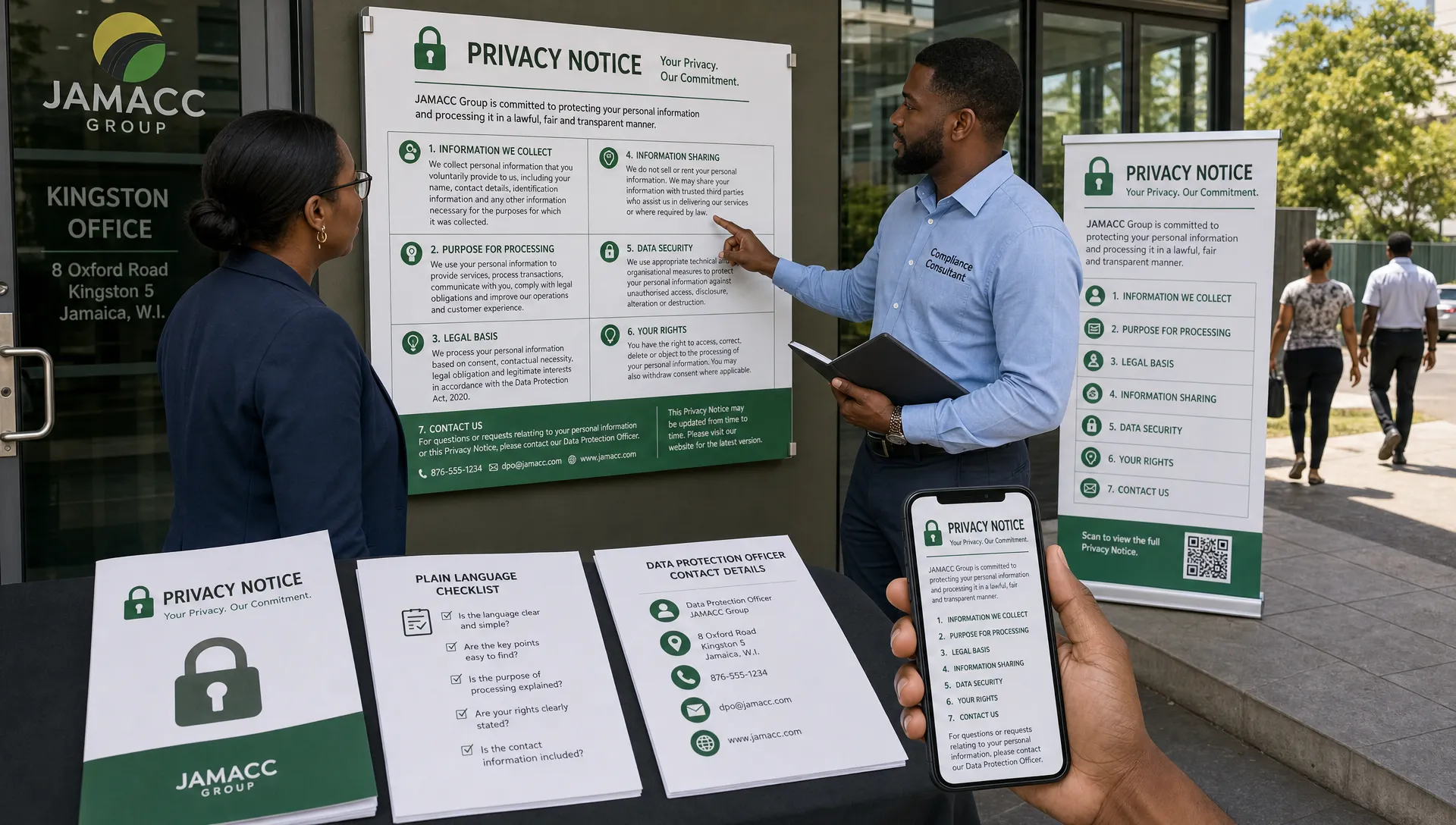
A privacy notice is often treated as a legal document first and a user communication second. That is why so many notices technically exist, but do not help people understand what is happening to their personal data.
For organisations in Jamaica, this is a missed opportunity. A well-written privacy notice supports compliance with the Data Protection Act, 2020, but it also builds trust with customers, employees, applicants, donors, patients, students, suppliers and website visitors. It tells people, in plain language, what you collect, why you collect it, who you share it with, how long you keep it and what choices or rights they have.
Better privacy notices are not longer. They are clearer, more specific and easier to use.
Why privacy notices fail real users
Many privacy notices fail because they are written from the organisation’s point of view. They begin with legal definitions, broad disclaimers and generic statements such as “we may collect information to improve our services.” That may feel safe, but it rarely answers the user’s real concern.
A real user wants to know things like: “If I fill out this form, who will see my information?” “Will you send me marketing messages?” “Is my data going overseas?” “Can I ask you to delete or correct it?” “How do I contact someone if I have a concern?”
The Office of the Information Commissioner in Jamaica emphasises transparency as a core part of data protection. International regulators take a similar approach. The UK Information Commissioner’s Office, for example, describes privacy information as something that should be concise, transparent, intelligible and easily accessible.
That standard is useful because it shifts the question from “Do we have a privacy notice?” to “Can a reasonable person understand this notice before giving us their information?”
Start with the questions people actually ask
Before drafting or revising a privacy notice, write down the questions a user is likely to have at the point where data is collected. This keeps the notice practical and reduces the temptation to copy a template that does not reflect your real operations.
User question | What your privacy notice should explain |
What information are you collecting? | The specific categories of personal data collected, such as contact details, identification information, payment data or employment records. |
Why do you need it? | The practical purpose, such as processing an application, delivering a service, meeting a legal obligation or responding to an enquiry. |
Do I have a choice? | Whether the data is required, optional or needed to enter into a contract or comply with law. |
Who will receive it? | Internal teams, service providers, regulators, professional advisers or other third parties, where relevant. |
How long will you keep it? | A clear retention period or the criteria used to decide retention. |
What can I do if something is wrong? | How the person can contact the organisation, ask questions or exercise applicable data protection rights. |
This user-first approach also helps you avoid vague language. If you cannot explain the purpose of collecting a category of data in one or two clear sentences, that may be a sign that the underlying process needs review.
For a deeper look at what people scan for first, PLMC has also discussed what users look for on privacy policy pages, including clarity around data collection, purpose, sharing and rights.
Build the notice from your data journey, not from a template
Templates can be useful starting points, but they are risky when used as substitutes for understanding your own data practices. A privacy notice should be built from the organisation’s actual data journey.
That means tracing what happens to personal data from the moment it is collected until it is deleted, anonymised, archived or otherwise no longer actively used. For example, a customer enquiry may begin on a website form, move into an email inbox, be entered into a customer management system, be shared with a sales or service team and later be retained for audit or service history purposes.
A simple mapping exercise should identify:
Where personal data is collected, including forms, calls, emails, applications, events, CCTV, cookies and in-person interactions.
What categories of personal data are collected at each point.
Why the organisation needs each category of data.
Which internal teams and external providers can access it.
Whether the data leaves Jamaica or is processed using overseas systems.
How long the data is kept and what happens at the end of that period.
Once you understand that journey, the privacy notice becomes easier to write. It stops being a legal guess and becomes a plain-language explanation of what your organisation actually does.
Use plain language without weakening legal accuracy
Plain language does not mean removing legal substance. It means explaining legal and operational points in language that a non-specialist can follow.
A good test is whether a customer service representative, HR officer, branch employee or school administrator could explain the privacy notice to a member of the public without needing a lawyer beside them. If the answer is no, the notice is probably too dense.
Instead of writing | Write something closer to |
“We process your personal data for legitimate business purposes.” | “We use your contact details to respond to your enquiry and manage our relationship with you.” |
“Your data may be disclosed to third parties where necessary.” | “We share your information with service providers who help us host our systems, process payments or deliver services.” |
“We retain data for as long as required.” | “We keep your information only for as long as needed for the purposes described in this notice, including legal, accounting and reporting requirements.” |
“Data subjects may exercise statutory rights.” | “You may contact us to ask about the personal data we hold about you or to request correction of inaccurate information.” |
The goal is not to oversimplify. The goal is to make the legal position understandable enough that a real person can make an informed decision.
Use a layered structure for different readers
Not everyone reads privacy information the same way. Some people want the short version. Others need detail, especially if the data involved is sensitive, financial, health-related, employment-related or legally required.
A layered privacy notice solves this problem by giving users the most important information first, then allowing them to read more if they need it.
A useful structure is:
Short notice at the point of collection: A brief statement near the form, sign-up page or physical collection point explaining the purpose of collection and linking to the full notice.
Main privacy notice: A complete but readable document covering data categories, purposes, legal basis where relevant, sharing, transfers, retention, rights and contact details.
Context-specific notices: Additional wording for special situations such as job applicants, CCTV, events, customer onboarding, children’s data or marketing communications.
This structure is especially helpful on mobile devices, where long blocks of text are difficult to read. Use clear headings, short paragraphs and descriptive links so users can quickly find the section that matters to them.

Make the notice specific to the Jamaican compliance context
For Jamaican organisations, privacy notices should align with the Data Protection Act, 2020 and the organisation’s real accountability framework. If your organisation also handles personal data from individuals in other jurisdictions, such as the European Union, you may also need to consider GDPR obligations. But for most local organisations, the Jamaican data protection compliance position should be clearly addressed first.
Your notice should make it easy to understand who is responsible for the personal data. Identify the organisation, provide appropriate contact details and explain how privacy queries can be raised. If a data protection officer or responsible privacy contact exists, make that route clear.
The notice should also explain purposes in a way that reflects local business and regulatory realities. For example, a regulated financial institution or designated non-financial business may need to collect identity documents and transaction information to meet anti-money laundering obligations. A healthcare provider may need medical information to deliver care. An employer may need employee records for payroll, benefits, statutory deductions and workplace administration.
Do not hide these purposes behind broad wording. If data is collected because the law requires it, say so in plain terms. If a user cannot receive a service without providing certain information, explain why.
For organisations reviewing the legal content of their notices, PLMC’s guide to must-have clauses for a Jamaican data privacy policy is a useful companion to the user-experience approach discussed here.
Write for moments of concern
The best privacy notices anticipate the moments when a user may feel uncertain. These moments often occur when the organisation asks for sensitive, unexpected or high-value information.
For example, a job applicant may understand why you need a résumé, but may be less clear about background checks, references or identification documents. A customer may understand why you need an email address, but may object if that email is automatically added to a marketing list. A visitor may accept CCTV for security, but still want to know who reviews the footage and how long it is kept.
Better privacy notices slow down at these points. They provide enough context to reduce confusion and prevent complaints.
This does not mean every privacy notice must explain every technical detail. Instead, it should give practical answers where the privacy impact is higher. If data is sensitive, mandatory, shared externally, used for automated decisions or transferred to cloud systems outside Jamaica, the explanation should be especially clear.
Be honest about cookies, analytics and marketing
Website privacy notices often become weak when they discuss cookies and analytics. Users are frequently told that cookies are used to “improve experience,” but not what that means in practice.
If your website uses analytics, advertising pixels, embedded tools, newsletter platforms or contact forms, your privacy notice should explain those activities in ordinary language. Users should be able to understand whether you are collecting technical information, tracking website behaviour, measuring campaign performance or sending marketing communications.
Marketing deserves particular care. Make the distinction between service messages and promotional messages clear. A service message might confirm an appointment or respond to an enquiry. A promotional message might advertise a new service, event or offer. People should not have to guess which one they are agreeing to receive.
If your organisation is building stronger internal rules around content, websites and reader trust, PLMC has also written about how to build a blog privacy standard readers trust.
Test the notice before publishing it
A privacy notice should be tested like any other important user-facing document. Legal review matters, but usability review matters too.
Ask a few people who were not involved in drafting the notice to read it and answer basic questions. What data is being collected? Why is it being collected? Who can it be shared with? How long is it kept? Who should they contact if they have a concern?
If they cannot answer those questions after reading the notice, the document needs improvement.
Also test the notice on a mobile device. Many users will read it from a phone, especially in Jamaica where mobile browsing is common. Long paragraphs, tiny text, unclear headings and PDF-only notices can make privacy information difficult to access at the moment it is needed.
Finally, compare the notice with your actual practices. If the notice says users can contact a privacy inbox, make sure someone monitors it. If it says data is kept for a defined period, make sure retention practices support that statement. A privacy notice creates expectations. Your operations must be able to meet them.
Common mistakes to avoid
Mistake | Why it creates risk | Better approach |
Copying a generic template | It may not match your real data practices. | Start with a data mapping exercise, then draft from reality. |
Using broad phrases like “business purposes” | Users cannot understand what will actually happen. | Name the specific purposes in plain language. |
Hiding important points in long paragraphs | Users miss key information about sharing, retention or rights. | Use headings, short sections and layered notices. |
Ignoring offline collection | Privacy notices often focus only on websites. | Cover forms, calls, events, CCTV, walk-ins and paper records. |
Publishing once and forgetting it | Data practices change over time. | Review the notice when systems, vendors, purposes or laws change. |
A practical privacy notice checklist
Before you publish or update a privacy notice, ask these questions:
Can a non-lawyer understand the main points in under five minutes?
Does the notice reflect what the organisation actually collects and does with data?
Are purposes specific rather than generic?
Are third-party sharing and overseas processing explained where relevant?
Are retention periods or retention criteria included?
Are privacy contact details easy to find?
Is the notice readable on mobile devices?
Has someone checked that internal procedures support the promises made in the notice?
If the answer to any of these questions is no, the notice may still be legally incomplete, operationally misleading or too difficult for real users to use.
Frequently Asked Questions
What is the difference between a privacy notice and a privacy policy? A privacy notice is usually written for individuals whose personal data is being collected or used. A privacy policy may also include broader organisational rules or internal governance commitments. In practice, many organisations use the terms interchangeably, but the key is that individuals receive clear information about how their data is handled.
How long should a privacy notice be? It should be long enough to explain your actual data practices, but short enough to remain usable. A layered structure works well because it gives users a concise summary first, then provides more detail for those who need it.
Should a Jamaican organisation mention the Data Protection Act, 2020 in its privacy notice? Yes, where relevant. The notice should not simply name the law, though. It should explain in practical terms how the organisation collects, uses, shares, protects and retains personal data in line with its obligations.
Can we use one privacy notice for everyone? Sometimes, but not always. A general notice may work for basic website visitors and customers, but employees, job applicants, patients, students or regulated clients may need more specific information because the data collected and purposes are different.
How often should privacy notices be reviewed? Review them whenever your data practices change, such as when introducing a new system, vendor, form, marketing activity, analytics tool or retention process. A scheduled annual review is also a good governance practice.
Make your privacy notice useful, not just available
A privacy notice should not sit on your website as a compliance decoration. It should help people understand what your organisation does with personal data and give them confidence that their information is being handled responsibly.
For Jamaican organisations, this is both a legal and trust-building exercise. Clear privacy notices support data protection compliance, reduce confusion and show that privacy is part of good governance.
If your organisation needs support reviewing privacy notices, strengthening data protection documentation or improving privacy awareness, Privacy & Legal Management Consultants Ltd. can help you approach compliance in a practical, risk-based way.