

How to Compare Privacy Laws Without Missing Key Duties

A useful comparison of privacy laws should tell your organisation what it must do, who must do it and what evidence will demonstrate compliance. For Jamaican businesses, comparing the Data Protection Act, 2020 with the EU General Data Protection Regulation (GDPR) or relevant US rules requires more than matching familiar terms such as consent, security and access rights. Similar language can conceal different thresholds, exceptions and reporting duties.
The most reliable approach is to compare obligations against actual processing activities. This guide explains how to build that comparison, identify differences that matter and turn your findings into operational controls.
Compare privacy laws by processing activity, not country alone
Start with a defined activity: recruiting employees, managing customer accounts, handling medical information or sending marketing messages. A country-by-country summary is useful background, but it cannot establish which rules apply to a particular workflow.
For each activity, record whose information you hold, where those people are located, which legal entity controls the processing and where suppliers store or access the information. Also identify whether your organisation acts as a controller, a processor or both in different relationships.
Legal scope is the first comparison, not an assumption. A company’s registered address does not settle every jurisdictional question. Equally, having an overseas customer does not automatically make every overseas privacy law applicable.
Under GDPR Article 3, a business outside the EU may fall within scope when offering goods or services to people in the EU or monitoring their behaviour there. The test is not simply whether someone has EU citizenship. Where Article 3(2) applies, the connection between the processing activity and the offering or monitoring matters.
US requirements need a separate assessment. State laws may have business thresholds and exemptions, while sector-specific rules use different tests. PLMC’s explanation of US privacy rules Jamaican firms may encounter provides useful context for this part of the exercise.
Establish which sources are authoritative
Use legislation, applicable regulations and official regulator guidance as your starting point. Record the version reviewed, commencement dates and any relevant transitional provisions. A recently published law may not yet impose every duty described in a summary article.
For Jamaica, use the Office of the Information Commissioner’s official resources to locate current guidance and check requirements relating to the Data Protection Act, registration and regulatory procedures. For the EU, refer directly to the official GDPR text.
Keep legal requirements separate from contractual promises. A customer agreement may impose a shorter incident-reporting deadline than legislation. That deadline belongs in your controls register, but it should not be labelled as a statutory obligation.
Build a duty-by-duty comparison matrix
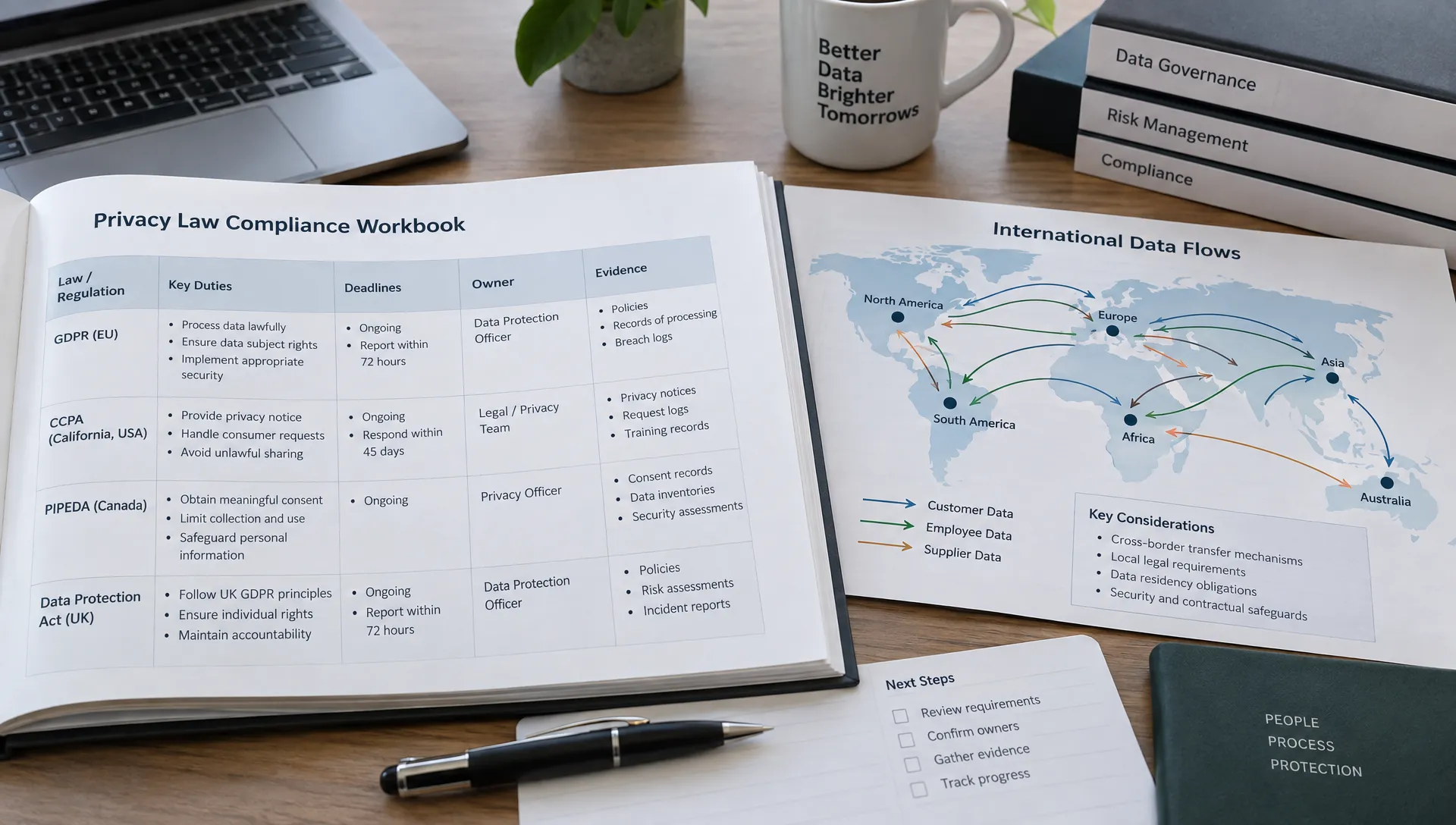
A practical matrix links each legal duty to the relevant activity, an operational control and evidence. Avoid a spreadsheet that merely marks “yes” beside broad topics such as security or consent.
Use the following structure as a starting point. The checkpoints identify matters to investigate, not a complete statement of either law.
Duty area | Jamaica checkpoint | GDPR checkpoint | Evidence to retain |
Scope and role | Confirm the Act’s application and controller obligations | Apply Article 3 and identify controller or processor responsibilities | Written scope assessment and data-flow map |
Lawful processing | Assess fair and lawful processing and applicable conditions | Identify an Article 6 basis and, where needed, an Article 9 condition | Purpose and legal-basis register |
Transparency | Check required information and how it is supplied | Assess Articles 13 and 14, including timing and exceptions | Approved notices and delivery records |
Individual rights | Identify applicable rights, procedures and statutory limits | Assess each relevant right and Article 12 response rules | Request log and response records |
Security and incidents | Check security standards and local breach duties | Separate Articles 32, 33 and 34 obligations | Risk assessments and incident decisions |
Overseas transfers | Assess the eighth data protection standard and applicable exceptions | Assess Chapter V requirements where applicable | Transfer assessment and supporting safeguards |
Governance | Check registration, officer and other applicable requirements | Test DPO, representative and DPIA requirements separately | Appointments, assessments and filings |
Add columns for the exact provision, trigger, deadline, exception, owner and review date. Those fields are what turn a comparison into a usable compliance tool.
Preserve differences instead of forcing equivalence
Jamaica’s Act sets out eight data protection standards. GDPR organises related duties through principles, rights and detailed accountability provisions. Similar objectives do not mean that corresponding obligations are interchangeable.
For example, a rule about lawful processing is not necessarily satisfied by the same consent form in both jurisdictions. Likewise, “sensitive personal data” under one law should not automatically be treated as identical to GDPR’s “special categories of personal data”. Compare the definitions and processing conditions explicitly.
Use clear status labels such as “applies”, “does not apply” and “requires legal review”. A blank cell can otherwise be mistaken for confirmation that no duty exists.
Examine the differences most likely to create missed duties
Lawful bases, consent and sensitive information
Compare the permitted grounds for processing against each purpose. Payroll administration, fraud prevention and promotional messaging may require different assessments even when they use information about the same person.
Under GDPR, identifying an Article 6 basis does not remove the need for an Article 9 condition when processing special-category data. Check the Jamaican requirements independently rather than copying the European justification into the local register.
Where consent is used, compare the requirements for obtaining it, documenting it and handling withdrawal. Consent to receive a service should not be assumed to authorise unrelated uses of personal information.
Your matrix should explain what happens operationally if the selected ground is unavailable. That might mean stopping a use, changing a collection process or seeking a different lawful justification before processing begins.
Rights, response periods and refusal grounds
List rights individually. Access, correction, erasure, objection and portability do not necessarily exist in the same form or apply in the same circumstances across laws.
For each right, record identity-verification requirements, permitted charges, refusal grounds and the response period. Keep the starting event alongside the deadline: a number without its trigger is easy to misapply.
GDPR Article 12 generally requires action on a rights request within one month of receipt. An extension of two further months is possible where necessary because of complexity or the number of requests, with notice to the individual within the first month. Do not automatically copy that timetable into your Jamaican procedure.
A shared intake process can work across jurisdictions, provided the case handler selects the applicable legal rules and records any exemption relied upon.
Breach reporting and notification thresholds
Compare incident duties at three levels: processor to controller, controller to regulator and controller to affected individuals. These are separate obligations with potentially different triggers and deadlines.
Under GDPR Article 33, a controller must notify the supervisory authority without undue delay and, where feasible, within 72 hours of becoming aware of a personal data breach, unless it is unlikely to result in a risk to people’s rights and freedoms. Article 34 applies a higher risk threshold for notifying individuals, subject to its exceptions.
Assess Jamaican reporting requirements separately. Record the applicable trigger, recipient, required information and timing, including any prescribed reporting procedure.
A short internal escalation deadline is not a substitute for legal analysis. Teams need enough time to assess the incident, document notification decisions and meet every applicable legal or contractual obligation.
International transfers and supplier access
Map access as well as storage. A foreign support team accessing information held in Jamaica can raise issues that a hosting-location checklist misses.
Jamaica’s eighth data protection standard addresses transfers outside Jamaica, including the adequacy of protection in the destination. GDPR Chapter V has its own framework for transfers to third countries or international organisations. A mechanism valid under one regime should not be assumed sufficient under another.
Identify the exporting and receiving entities, onward transfers and the role of each supplier. Then assess the applicable mechanism, safeguards or exception for each relevant regime.
Keep processor-contract requirements separate from transfer requirements. A general confidentiality clause or a claim that a supplier is “GDPR compliant” does not establish that either assessment has been completed.
Test the comparison against a real business workflow
Consider a Jamaican company offering an online service to people in France and using a US-based customer-support provider. Its comparison should address the service, local employee administration and outsourced support as distinct processing activities.
For the French-facing service, examine GDPR’s territorial scope alongside the Jamaican Act. Then check the privacy notice, processing grounds, relevant rights and any applicable overseas representative requirement. Do not assume that conclusions about this service automatically apply to every employee record held by the company.
For the support provider, assess its role, contractual duties, access arrangements and relevant transfer requirements. US hosting alone neither establishes that every US state privacy law applies nor resolves the Jamaican and European obligations.
Finally, test an incident: the provider reports unauthorised access to support records. Can the team identify affected jurisdictions, distinguish contractual notification from statutory reporting and locate the evidence needed for a decision?
If that exercise exposes unanswered questions, the matrix is not yet operational, even if its legal summaries look complete.
Check sector rules alongside privacy legislation
Privacy laws may sit beside health-sector confidentiality, employment, anti-money laundering or product-regulatory requirements. These can affect record retention, permitted disclosures and the handling of sensitive information.
For example, a medical-device business comparing privacy obligations may also need specialist medical-device and IVD regulatory support for its separate product-compliance work. Keeping the two workstreams connected helps identify records that serve both purposes without treating product regulation as a substitute for privacy compliance.
Where retention duties appear to conflict with an erasure request, identify the specific record and legal requirement. A sector obligation should not become a blanket justification for retaining every related file indefinitely.
Turn identified differences into assigned controls
Classify each finding as a shared requirement, a jurisdiction-specific addition or a potential conflict requiring review. Shared requirements can often use one process, while local additions need a clear branch in that process.
For example, one rights-request form may support several jurisdictions, but the response procedure must still apply the correct rights, limits and deadlines. A single incident plan can work similarly, with separate notification decision paths.
Assign an accountable owner to each control. Procurement may own supplier contracting, HR may manage employee requests and the privacy lead may coordinate legal interpretation. PLMC’s discussion of privacy roles, duties and evidence can help connect those assignments to demonstrable accountability.
Give every unresolved issue a decision date. Review the comparison when laws change, a new market is entered, a supplier changes or processing materially expands. An annual review alone may miss a significant change introduced during the year.
The finished output should contain three things: an applicability assessment, a duty-level matrix and an action register showing owners, evidence and outstanding gaps.
Frequently Asked Questions
Is complying with GDPR enough to meet Jamaica’s Data Protection Act? No. GDPR controls may support parts of a Jamaican programme, but local scope, standards, registration and other applicable duties still require their own assessment.
Should we always follow the strictest privacy law? A higher internal standard can simplify some controls, but “strictest” does not resolve different definitions, regulatory filings, legal grounds or conflicting requirements. Assess each applicable duty separately.
Can one privacy notice cover several countries? Often, but it must accurately address the relevant entities, processing activities and legally required information. Jurisdiction-specific sections may be needed, and publishing a notice does not establish lawful processing by itself.
When does a comparison need legal review? Seek review when applicability is uncertain, laws appear to conflict or a proposed exemption materially affects individuals. Sensitive-data processing, international transfers and disputed rights requests also deserve careful assessment.
Get support with your Jamaican compliance assessment
A privacy-law comparison is useful only when it changes how your organisation handles personal information. Start with one significant workflow, establish which laws apply and connect every identified duty to an owner and evidence.
Privacy & Legal Management Consultants Ltd. offers data protection implementation, GRC integration and training for organisations in Jamaica. Request a free consultation to discuss how your comparison can support a practical compliance programme. Use this guide as a working method, not as a substitute for advice on your organisation’s specific legal obligations.