
Difference Between Data Protection and Data Security Explained

Many organisations treat “data protection” and “data security” as the same thing. They are closely connected, but they are not interchangeable. Confusing them can leave gaps, for example, strong cyber controls with weak privacy governance, or compliant-looking policies with poor technical safeguards.
In Jamaica, that distinction matters even more as organisations work to operationalise obligations under the Data Protection Act. Understanding where data protection ends, where data security begins, and where they overlap helps you design a programme that is both compliant and resilient.
Clear definitions (in plain English)
What is data protection?
Data protection is the law, governance, and operating discipline that ensures personal data is handled properly throughout its lifecycle.
It focuses on questions like:
Should we collect this personal data at all?
What is the lawful basis or justification for using it?
Did we tell the individual what we are doing (transparency)?
Are we using it only for the stated purpose (purpose limitation)?
How long should we keep it (retention and disposal)?
Can the individual access, correct, object, or request deletion (rights handling)?
Who is accountable, and what evidence shows we comply (accountability)?
In other words, data protection is about fairness, legality, and responsible use of personal data, not only about keeping it “safe from hackers.”
What is data security?
Data security is the technical and organisational protection of data (personal data and non-personal data) against unauthorised access, alteration, loss, or destruction.
It focuses on questions like:
Who can access the data, and how do we enforce that (access control, MFA)?
How do we prevent and detect attacks (monitoring, patching, hardening)?
How do we reduce the impact of incidents (backups, segmentation, response plans)?
How do we secure endpoints, networks, cloud services, and applications?
Frameworks and standards often used for data security include resources from NIST and ISO/IEC guidance published by ISO.
The difference between data protection and data security (quick comparison)
Here is a practical way to separate the two without oversimplifying:
Area | Data protection | Data security |
Primary goal | Lawful, fair, transparent handling of personal data | Protect data and systems from threats and failures |
Main scope | Personal data (and often special or sensitive categories) | All data and systems (personal, financial, IP, operational) |
Key questions | “Should we?” “Are we allowed?” “Did we inform?” “How long?” | “How do we secure it?” “Who can access?” “How do we detect and recover?” |
Typical outputs | Privacy notices, DPIAs/PIAs, records of processing, retention schedules, DSAR workflows, vendor privacy clauses | Security policies, access controls, encryption, logging, vulnerability management, incident response, backups |
Success evidence | Demonstrable compliance, governance, audit-ready records | Reduced risk, fewer incidents, quicker detection and recovery |
Common owners | DPO or privacy lead, legal/compliance, governance | CISO/IT security, IT operations, security vendors |
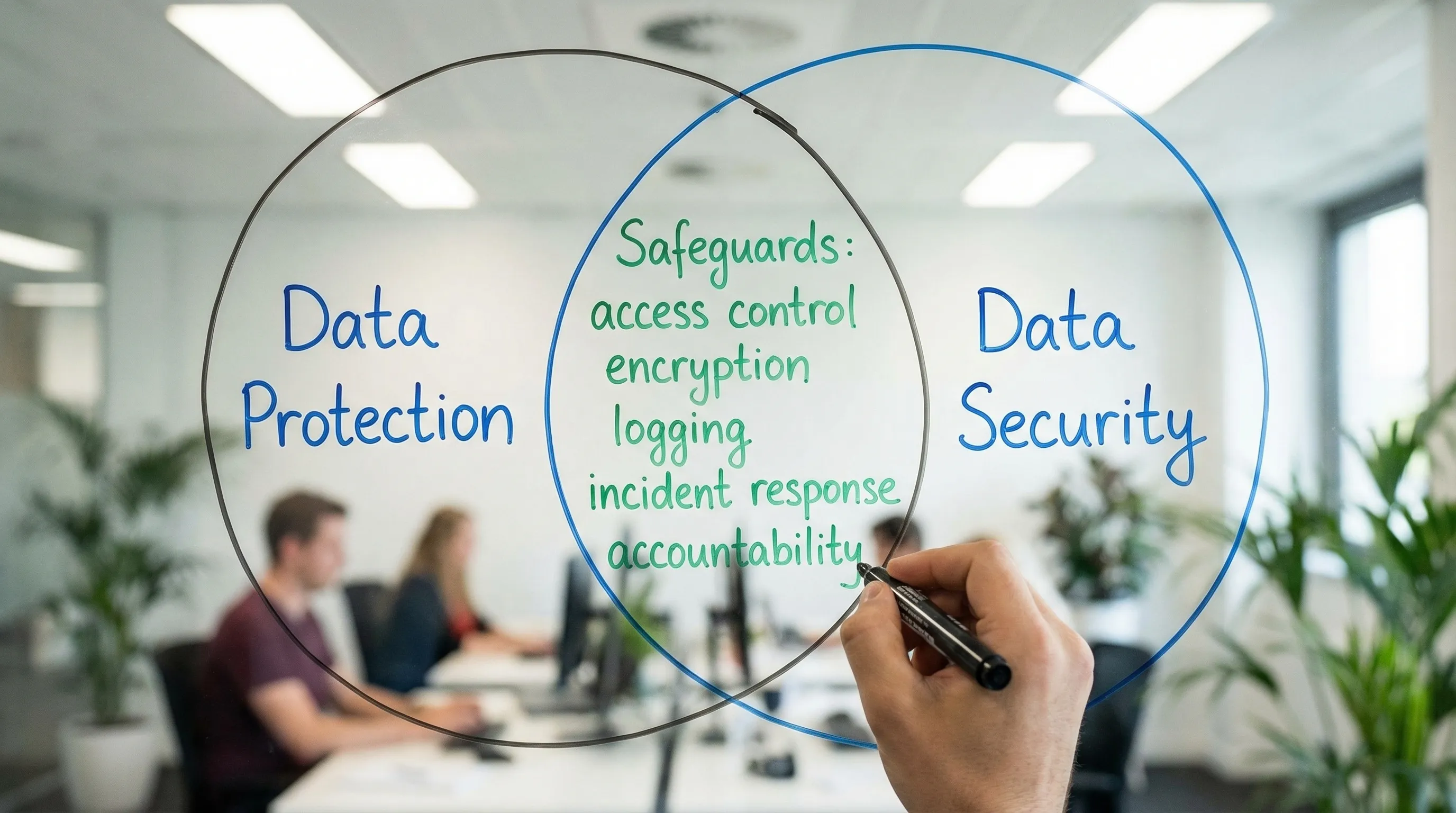
The key message: data security is a major component of data protection, but data protection includes much more than security.
Where they overlap (and why you need both)
Data protection and data security meet in the real world because privacy laws require “appropriate” safeguards, and security programmes handle data that often includes personal information.
The overlap typically includes:
Access control (only authorised staff can see HR files, customer records, or CCTV footage)
Confidentiality controls (encryption, secure sharing, preventing accidental disclosure)
Integrity controls (ensuring records are not altered improperly)
Availability and resilience (keeping critical services running and data recoverable)
Incident management (knowing when an incident becomes a reportable personal data breach)
If you invest heavily in security but ignore privacy governance, you can still fail data protection expectations (for example, collecting too much data, keeping it too long, or using it for a new purpose without proper justification). If you invest heavily in privacy documents but neglect security controls, you may be compliant on paper but exposed in practice.
Practical examples Jamaican organisations recognise
Example 1: HR records
Data protection issue: Keeping copies of IDs, TRN, medical notes, or disciplinary records without a clear retention rule, or sharing details more broadly than needed.
Data security issue: HR files stored in a shared drive where “everyone” has access, weak passwords, or no MFA for cloud email.
You need both: a retention schedule and role-based access control.
Example 2: Customer onboarding and KYC
Data protection issue: Not clearly explaining why you need certain documents, not aligning usage with the stated purpose, or failing to respond properly to a data subject request.
Data security issue: Storing customer documents unencrypted, emailing scans insecurely, or not monitoring for exfiltration.
This is where privacy, AML compliance, and cyber security frequently intersect.
Example 3: CCTV at offices and retail locations
Data protection issue: Inadequate signage, unclear purpose, excessive retention, or uncontrolled disclosure of footage.
Data security issue: Default passwords on DVR/NVR devices, exposed remote access, or unmanaged vendor access.
A privacy-forward CCTV programme includes signage, policies, retention limits, and technical hardening.
Example 4: Marketing lists and WhatsApp broadcasts
Data protection issue: Unclear consent or opt-out, collecting contacts for one purpose and reusing for another, or failing to honour objections.
Data security issue: A compromised staff phone or account exposing the full list of customers.
Data security incidents vs personal data breaches
A common operational gap is treating every incident as “an IT matter” or, conversely, treating every IT alert as a legal breach.
A security incident is any event that threatens confidentiality, integrity, or availability (malware, lost laptop, suspicious login, misconfiguration).
A personal data breach is a security incident that results in accidental or unlawful destruction, loss, alteration, unauthorised disclosure of, or access to personal data.
Not every security incident becomes a personal data breach, but many do. The difference determines escalation, documentation, communications, and regulatory considerations.
A strong programme aligns these teams so that:
Security can quickly identify whether personal data is involved.
Privacy can assess impact to individuals and determine next steps.
Leadership receives a clear, evidence-based briefing.
For general security guidance widely referenced by privacy regulators, the UK Information Commissioner’s Office has useful material on security measures and protecting personal data.
What “good” looks like: mapping privacy requirements to security controls
Organisations often ask: “If we have ISO-style security controls, are we automatically compliant?” Not automatically. Strong security is a big advantage, but privacy compliance also needs governance, purpose controls, and rights handling.
Here is a practical mapping to help you spot what may be missing:
Privacy requirement (data protection) | Typical supporting security controls | Typical non-security operational controls |
Data minimisation | Access control, secure forms | Limit fields collected, remove optional data, staff scripts |
Purpose limitation | Logging, change control | Approval process for new uses, governance sign-off |
Storage limitation (retention) | Secure deletion, backups policy | Retention schedule, records management, disposal procedures |
Individual rights (access/correction/objection) | Authentication, secure portals | DSAR workflow, identity verification steps, response templates |
Accountability | Audit logs, monitoring | Records of processing, DPIAs/PIAs, training attendance, vendor registers |
Vendor oversight | Secure VPN, restricted access | DP clauses, due diligence questionnaires, cross-border assessments |
Common misconceptions (and the risk they create)
“We are secure, so we are compliant.”
A secure environment can still be non-compliant if, for example, you keep personal data indefinitely, reuse it for new purposes without justification, or fail to respond to requests from individuals.
“Privacy is a legal document exercise.”
Privacy notices, policies, and consent language matter, but they do not prevent account takeovers, ransomware, phishing, or data leaks. Privacy must be operational.
“IT owns privacy.”
IT owns many safeguards, but privacy requires cross-functional ownership: HR, operations, customer service, procurement, legal, risk, and senior management.
How to align data protection and data security in a single programme
You do not need two separate worlds. The best approach is a joined-up GRC model where privacy sets the “rules of use” and security enforces “rules of protection.”
1) Build a shared data inventory (not just an asset list)
A security asset inventory (systems, devices, applications) is not the same as a privacy data inventory (types of personal data, purposes, recipients, retention, transfers). You need both, connected.
2) Define roles and escalation paths
Even in smaller Jamaican organisations, it helps to document:
Who approves new personal data uses
Who owns incident response
Who decides whether an incident is a personal data breach
Who handles requests from individuals
3) Use risk assessments that cover privacy and cyber
A security risk assessment might prioritise threats like ransomware, while a privacy impact assessment looks at harm to individuals (discrimination, financial loss, distress, reputational impact). Mature organisations evaluate both.
4) Train by job role, not generic awareness only
Security training (phishing, passwords, device hygiene) should sit alongside privacy training (handling requests, sharing rules, data minimisation, retention). Role-based training reduces mistakes that cause real-world breaches.
5) Test your breach readiness
Tabletop exercises should include privacy, communications, legal, and operations, not only IT. The objective is speed and clarity: what happened, what data, whose data, impact, containment, next steps, evidence.
Frequently Asked Questions
Is data protection the same as cyber security? No. Cyber security is primarily about protecting systems and data from threats. Data protection is broader, it includes lawful use, transparency, minimisation, retention, rights, and accountability.
Can we be compliant with the Data Protection Act if our security is weak? Strong compliance is difficult with weak security because appropriate safeguards are a core expectation. Even with good policies, weak controls increase the likelihood of a personal data breach.
Does data security only apply to personal data? No. Data security applies to all data types, including intellectual property, financial records, operational data, and personal data.
Who should own data protection vs data security in an organisation? Data protection is usually owned by a privacy lead (often with legal/compliance and governance), while data security is owned by IT/security leadership. Both must coordinate through a shared risk and incident process.
What is the quickest way to identify gaps between data protection and data security? Start with a combined assessment: map your personal data processing activities, then test whether access controls, retention, vendor oversight, and incident response work in practice.
Need help aligning privacy compliance and security controls?
If your organisation is updating policies for the Data Protection Act while also strengthening cyber security, PLMC can help you connect the dots in a practical, audit-ready way. We support Jamaican organisations with data protection implementation, cyber security services, training, risk assessments, and broader GRC integration.
Explore PLMC’s resources at Privacy & Legal Management Consultants Ltd. or request a free consultation to discuss your current gaps and next steps.