

Data Protection Privacy Policy: How to Draft It Right

If you are subject to Jamaica’s Data Protection Act, a generic online “privacy policy template” is one of the fastest ways to create compliance risk. The safest approach is to draft a data protection privacy policy (and any supporting privacy notices) from what your organisation actually does with personal data, then write it in plain language that people can understand.
This guide breaks down what to include, how to structure it, and the common mistakes that get organisations into trouble.
First, clarify what you mean by “privacy policy”
In practice, organisations use the term privacy policy to describe different documents. Getting this wrong causes gaps.
External privacy notice (customer, website visitor, client, member): The transparency statement you publish on your website, in forms, apps, or onboarding flows.
Employee privacy notice: A separate notice explaining how you use staff data (recruitment, payroll, performance management, monitoring, benefits).
Internal data protection policy: The internal rules for staff (how to handle requests, retention, security, incident reporting). This is not a substitute for an external notice.
Most organisations in Jamaica need at least an external privacy notice and an internal data protection policy. Many also need a dedicated employee notice.
What the Data Protection Act expects your policy to achieve
A privacy policy is not just a website page. It is evidence of transparency and accountability. It should allow a person to understand:
What personal data you collect
Why you collect it (purposes)
The lawful basis/justification for using it
Who you share it with (including vendors)
How long you keep it
How individuals can exercise their rights
How you keep it secure (at a high level)
If your organisation cannot back up the statements with real operational practices (for example, retention rules, vendor contracts, access controls), the policy becomes a liability.
Step-by-step: How to draft a data protection privacy policy that holds up
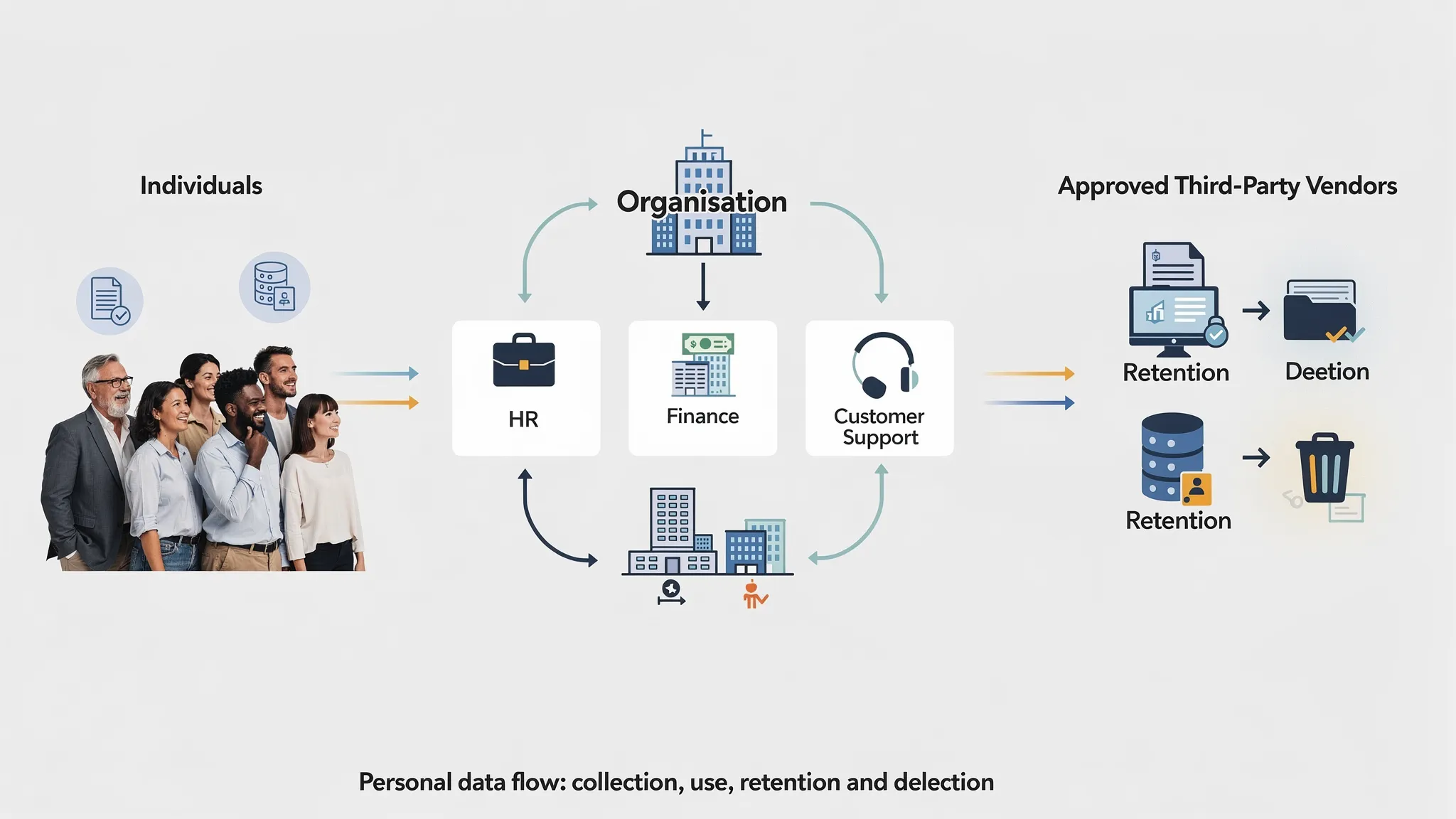
Step 1: Start with a data map (not a template)
Before writing a single sentence, list your processing activities. If you do not have a full register yet, you can still draft a policy by mapping your “top 10” data flows.
At minimum, capture:
Data subjects (customers, website visitors, staff, suppliers)
Data types (IDs, contact info, financial data, health data, images, device data)
Collection channels (web forms, WhatsApp, phone, CCTV, HR systems)
Purposes (deliver service, prevent fraud, payroll, marketing)
Storage locations (email, cloud platforms, physical files)
Recipients (banks, payroll providers, couriers, IT support)
Cross-border transfers (if any)
Step 2: Decide what document(s) you actually need
Many organisations try to force everything into one “website privacy policy.” That often creates confusion for staff and the public.
A practical approach is:
One public-facing privacy notice (website + customers)
One employee privacy notice
One internal data protection policy (staff rules and governance)
You can cross-reference them, but do not mix audiences. A customer should not have to read payroll and disciplinary monitoring details to understand how you use their order information.
Step 3: Draft an outline that matches the individual’s questions
People scan. Your headings should answer real questions like:
“What do you collect?”
“Why do you need it?”
“Who do you share it with?”
“How can I get access or request correction?”
A clear structure also makes it easier to prove transparency during an audit or investigation.
Step 4: Write the content using plain language, then add legal precision
Your privacy policy should be readable to a non-lawyer. Plain language does not mean vague language.
Good: “We keep invoices for X years to meet tax and accounting requirements.”
Risky: “We retain data as long as necessary.” (without explaining what “necessary” means in your context)
For general transparency best practices, the UK Information Commissioner’s guidance on privacy information is a useful benchmark for clarity and structure, even though Jamaica’s legal framework is not identical.
Step 5: Check consistency with operations (the most skipped step)
A policy is only defensible if your operations match it. Before publishing:
Confirm retention periods exist (even if approximate by category)
Confirm your vendors match your disclosure (payment processors, HR platforms, cloud providers)
Confirm you can actually handle rights requests (access, correction, deletion where applicable)
Confirm your security statements are true (avoid claiming “we encrypt everything” if you do not)
Step 6: Put version control and review dates in place
Privacy policies should be living documents. Trigger a review when you:
Launch a new product, app, or data collection channel
Start new marketing activity (email/SMS targeting)
Add a new vendor that processes personal data
Begin cross-border processing (new cloud region, overseas support team)
Change how you use CCTV, biometrics, or monitoring tools
What to include: A practical policy blueprint
Below is a solid structure for a Jamaica-focused privacy policy (external notice). You can adapt it based on your organisation and risk profile.
1) Who you are and how to contact you
Include:
Legal entity name
Address and contact details
Your data protection contact point (DPO or privacy lead, if assigned)
If you operate multiple brands or subsidiaries, clarify which entity controls the processing.
2) What personal data you collect
Group by category so readers can understand quickly, for example:
Identification and contact details
Account and transaction information
Communications (emails, calls, chat logs)
Device/online identifiers (if you use analytics)
CCTV images (if applicable)
Do not list vague catch-alls like “any information you provide.” Be specific.
3) Why you collect it and the lawful basis
For each purpose, explain:
The purpose in plain language
The justification or legal basis you rely on (for example, contract performance, legal obligation, consent, legitimate interests where applicable)
This is where “template policies” usually fail, because they include purposes the organisation does not actually have.
4) Who you share personal data with
Disclose recipient categories clearly:
Payment providers and banks
Delivery/logistics providers
IT and cloud service providers
Professional advisers (lawyers, auditors)
Regulators and law enforcement (when legally required)
If you use processors, your vendor contracts should reflect appropriate data protection obligations.
5) Cross-border transfers
If personal data is accessed or stored outside Jamaica (common with cloud email, CRM systems, HR platforms), say so.
Explain, at a high level, what safeguards you use (for example, contractual commitments, vendor due diligence, access controls). Avoid naming a safeguard you do not actually have in place.
6) Retention (how long you keep data)
Provide retention by category where you can. Even if you cannot give exact timelines for every dataset, you should give meaningful guidance.
Examples of retention drivers:
Accounting and tax requirements
Contract limitation periods
Regulatory obligations (sector-specific)
Security and fraud investigation needs
7) Individual rights and how to make a request
Explain how individuals can exercise their rights and what information you need to verify identity.
Include:
Request channels (email, web form, physical address)
What you will do to confirm identity
Typical response timeframes (do not promise what you cannot deliver)
8) Security (high-level, accurate)
You do not need to reveal sensitive security details, but you should describe your approach:
Access control and least privilege
Staff training and confidentiality
n- Secure disposal
Incident response and breach management
Avoid absolute statements like “100% secure.”
9) Cookies and analytics (if applicable)
If your website uses analytics, ad tracking, embedded videos, or social media pixels, disclose:
What tools you use (by category, or by name if you prefer)
What data is collected (IP address, device identifiers, usage)
Choices available (cookie settings, browser controls)
10) Children’s data (if relevant)
If you provide services to minors or knowingly collect children’s data (schools, youth programmes, health services), add a dedicated section describing your approach to consent and safeguards.
11) Updates to the policy
State how you will notify people of material changes (website notice, email, in-app notification) and show an effective date or version.
A “policy drafting” table you can use internally
This table helps teams translate their data map into policy content without losing accuracy.
Policy section | Inputs you need from the business | Common drafting risk | What “good” looks like |
Data collected | Forms, systems, HR files, CCTV, call logs | Missing a major category (CCTV, WhatsApp, call recordings) | Grouped categories, plain language examples |
Purposes and legal basis | Why each team uses the data | Copy-pasting bases that do not apply | One purpose, one justification, written clearly |
Sharing and vendors | Vendor list, contracts, integrations | Forgetting cloud providers and support tools | Vendor categories disclosed, aligned to contracts |
Cross-border transfers | Where systems are hosted, who can access | Saying “we never transfer data” when using cloud services | Honest disclosure plus safeguards summary |
Retention | Retention schedule, regulatory rules | “We keep data as long as necessary” only | Category-level timeframes and criteria |
Rights requests | Internal process, request mailbox, ID verification | Promising timelines you cannot meet | Clear steps, verification, escalation path |
Security | Actual controls and policies | Overstating security capabilities | High-level, accurate, risk-based wording |
Common mistakes that weaken a privacy policy
Treating the policy as a marketing page
A privacy policy is a compliance document. If it reads like promotional copy, it often becomes vague and omits key disclosures.
Using “we may” everywhere
Overuse of “we may collect” or “we may share” can look like you are reserving the right to do anything. It is better to describe what you actually do, and name the limited scenarios where you might do more.
Forgetting employee and CCTV processing
Even if your website policy is strong, organisations often under-document:
Recruitment and HR processing
Visitor logs and building access systems
CCTV and security monitoring
Those areas are high sensitivity and high complaint risk.
Listing rights without a working process
If your policy invites access or correction requests but your staff do not know how to respond, you create operational and reputational risk. Draft the process first, then publish the promise.
Publishing a policy that does not match your contracts
Your privacy policy and your vendor agreements should tell the same story. If the policy says “we never share data,” but your operations use third-party processors, that mismatch is hard to defend.
Quick self-check before you publish
Ask these questions internally:
Can we name every system where customer and employee personal data lives?
Could we explain our retention periods to an auditor without guessing?
Do we have a clear channel for rights requests and a process to verify identity?
Does our vendor list match what the policy discloses?
If a breach happened tomorrow, do we know who leads, who investigates, and who communicates?
If any answer is “no,” adjust the operations or narrow the policy so it stays truthful.
Frequently Asked Questions
Is a privacy policy the same as a data protection policy? No. A privacy policy usually means an external privacy notice for the public. A data protection policy is typically internal, it sets rules and responsibilities for staff. Most organisations need both.
Do Jamaican organisations need a website privacy policy even if they do not sell online? If you collect personal data through your website (contact forms, newsletter sign-ups, analytics identifiers, job applications), you should provide clear privacy information at the point of collection.
Can I use a privacy policy generator or template? You can use a template as a starting format, but you still must fill it with accurate details from your own processing activities (data collected, purposes, retention, sharing, cross-border use). Copy-paste policies are a common source of non-compliance.
Should employees have a separate privacy notice? Often, yes. Staff data use is typically broader and more sensitive than customer data (payroll, benefits, performance, monitoring). A separate employee notice is clearer and reduces risk.
How often should we update our privacy policy? Review at least annually, and immediately when you introduce new data uses, new vendors, new tracking technologies, or new cross-border processing.
Need help drafting a defensible privacy policy in Jamaica?
A strong data protection privacy policy is built from your real data flows, vendor arrangements, and rights-handling process, not from generic wording. If you want support mapping your processing, drafting your notices, and aligning them with Jamaica’s Data Protection Act and day-to-day operations, PLMC can help.
Book a consultation with Privacy & Legal Management Consultants Ltd. at privacymgmt.org to get your privacy policy drafted (or corrected) in a way that is practical, accurate, and audit-ready.