

Data Protection and Data Security: Who Owns What Internally?

Most organisations don’t struggle with whether they should protect data, they struggle with who owns which parts of the job once the work gets real: a new HR system, a phishing incident, a marketing campaign, a vendor onboarding, or a Data Protection Act question from a customer.
That confusion is risky. When ownership is unclear, privacy controls get written but not implemented, security controls get implemented but not evidenced, and critical tasks fall between departments. This article breaks down how to separate and assign ownership for data protection and data security internally, in a way that fits Jamaican organisations and the accountability expectations under the Data Protection Act.
Data protection vs data security (why the difference matters)
These terms are often used interchangeably, but they are not the same.
Data protection is about lawful and fair use of personal data and being able to demonstrate compliance. It includes things like:
What personal data you collect and why
Lawful basis, notices, consent (where used)
Handling access, correction, objection, and other rights requests
Retention and disposal rules
Vendor governance and data sharing decisions
Accountability evidence (policies, records, training, risk assessments)
Data security is about protecting data against unauthorised access, alteration, loss, or disclosure, using technical and organisational controls. It includes things like:
Access control, MFA, password standards
Network security, endpoint protection
Logging and monitoring
Encryption, backups, patching
Secure configuration and vulnerability management
Incident detection and response
They overlap heavily, but ownership is not identical. Privacy programmes fail when an organisation treats data protection as “a legal policy problem” and security programmes fail when an organisation treats security as “just an IT problem.”
The core question: who owns what internally?
In healthy governance, ownership works on three levels:
Accountability: one role ultimately answers for outcomes (typically senior leadership).
Operational responsibility: teams that do the work day-to-day.
Assurance and oversight: independent review (internal audit, risk, compliance).
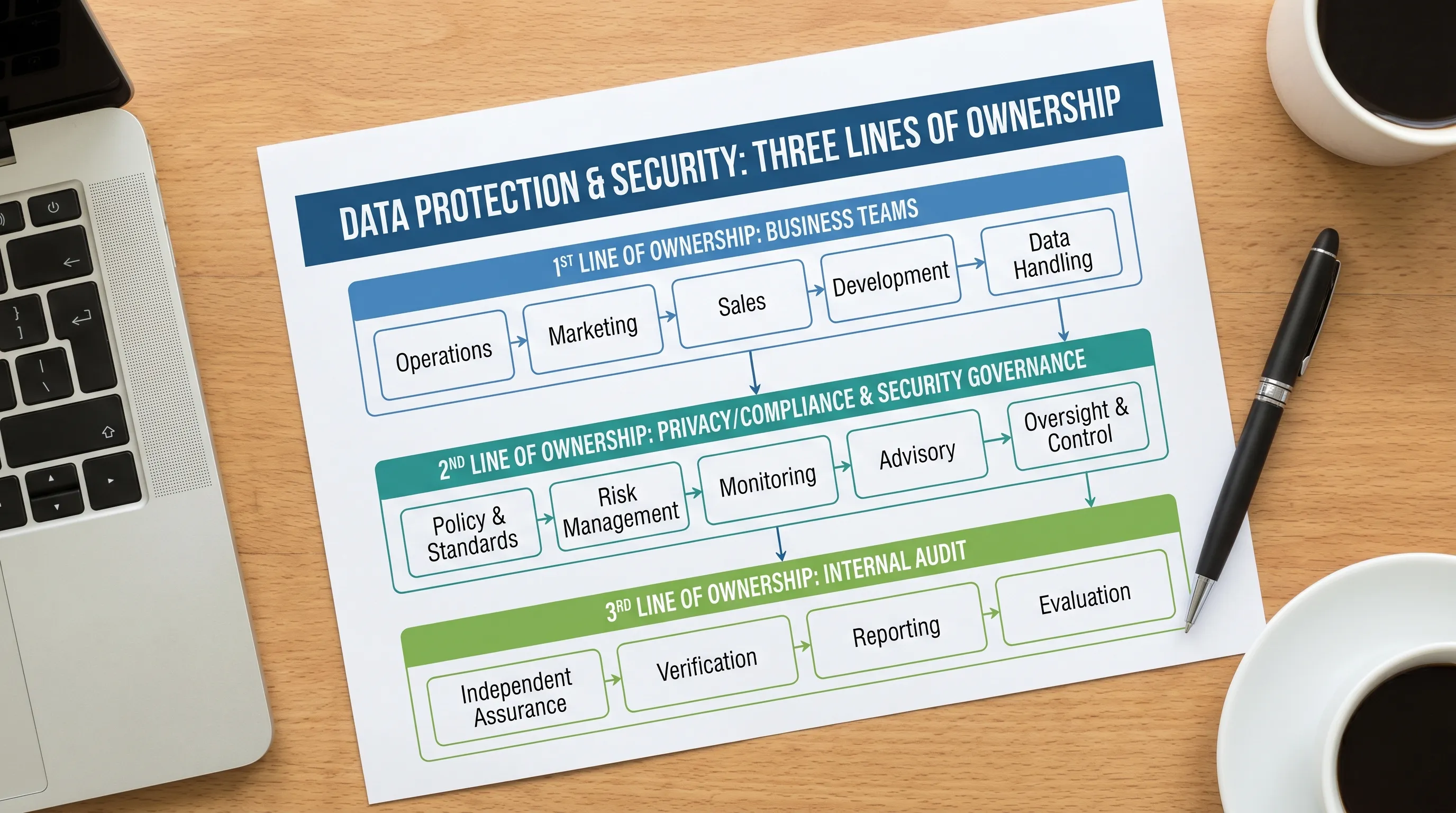
A practical way to implement this is to structure ownership using a “three lines” model:
First line (business and operations): departments that collect and use data (HR, Customer Service, Marketing, Finance, Operations). They “own” the processes.
Second line (risk, privacy, compliance, security governance): sets standards, advises, monitors, challenges.
Third line (internal audit): provides independent assurance.
In many Jamaican organisations, the gap is that the first line assumes the second line “owns” the controls, while the second line assumes IT or the business “owns” implementation. That is where breaches and compliance failures are born.
A simple ownership framework you can adopt (without overcomplicating it)
Use this rule of thumb:
The business owns the data and the purpose (why it is collected and how it is used).
IT and security own the protection mechanisms (how it is secured and kept available).
Privacy/compliance owns the compliance method (how you prove it is lawful, fair, and accountable).
Leadership owns the risk decision (what risk is accepted, funded, or avoided).
Common internal roles (and what they should typically own)
Board and executive leadership
Approve the organisation’s risk appetite for privacy and cyber risk
Ensure resources are provided (budget, staffing, tools)
Receive reporting on incidents, risks, and compliance status
Privacy lead / Data Protection Officer (where appointed)
Defines privacy governance and standards
Maintains privacy documentation (records, notices, policies)
Oversees rights request workflow design and evidence
Advises on DPIAs or privacy risk assessments for new initiatives
Information security lead (CISO or IT security manager)
Sets security standards (access control, logging, encryption, patching)
Runs incident response and technical containment
Oversees security monitoring, vulnerability management, backup strategy
Legal / compliance
Interprets regulatory obligations and contractual risk
Reviews data sharing terms and key clauses (where applicable)
Supports regulatory communications strategy during incidents
Business process owners (HR, Marketing, Operations, Customer Service, Finance)
Decide what data is needed and ensure minimisation
Maintain process-level controls (who can access, when, why)
Ensure frontline staff follow scripts and procedures
Keep operational evidence (forms, logs, approvals)
Procurement / vendor management
Ensures vendor due diligence happens before onboarding
Coordinates security and privacy requirements into contracts and renewals
Internal audit (or an independent assurance function)
Tests whether controls exist, work, and are evidenced
Reports findings independently
RACI model: who is Responsible, Accountable, Consulted, Informed?
If your organisation has been stuck in debates like “that’s IT” vs “that’s Compliance,” a RACI table makes the handoffs explicit.
Below is a practical example you can adapt. Roles are intentionally generic so SMEs and larger entities can map them to their structure.
Activity | Accountable | Responsible | Consulted | Informed |
Maintain data inventory and processing records | Business executive sponsor | Privacy lead with process owners | IT, Legal, Security | Leadership team |
Draft and update privacy notices | Privacy lead | Privacy lead | Legal, Marketing, Customer Service | Process owners |
Access control standards and MFA rollout | IT/Security lead | IT/Security team | Privacy lead, HR | Leadership team |
Vendor onboarding and due diligence | Procurement lead | Procurement with Security and Privacy | Legal, Process owner | Leadership team |
Data retention schedule and disposal process | Privacy lead | Process owners | Legal, IT (systems), Security | Leadership team |
Rights requests intake and response workflow | Privacy lead | Customer Service/HR (as applicable) | Legal, IT, Security | Process owners |
Incident response (technical containment) | IT/Security lead | IT/Security team | Privacy lead, Legal, Comms | Leadership team |
Incident response (notifications and messaging) | Executive leadership | Privacy lead / Legal / Comms | IT/Security | Staff on need-to-know |
Privacy risk assessment for new projects | Executive sponsor | Privacy lead and project owner | Security, Legal, IT | Leadership team |
Security awareness training | HR lead | HR with Security and Privacy | Privacy lead, IT/Security | All staff |
How to use this table:
Put it in your governance pack and get leadership sign-off.
Add names, not just departments.
Attach evidence expectations (what “done” looks like) for each activity.
Where ownership usually breaks down (and how to fix it)
1) Marketing, websites, and analytics
Marketing often touches personal data through sign-up forms, contact pages, customer lists, pixels, and email campaigns. Security focuses on the website’s technical hardening, while privacy focuses on notices, cookies, lawful basis, and vendor terms.
If you work with outside marketing partners, treat them like any other vendor: define what data they access, ensure appropriate contractual terms, and limit access to what they need. Even if you are only seeking growth support (for example, from an agency offering affordable SEO services for small businesses), your vendor onboarding should still cover privacy and security expectations because marketing frequently touches personal data.
2) HR and employee data
HR systems can contain sensitive categories of personal data. Ownership fails when HR believes IT “handles privacy,” or when IT secures the system but HR has no retention rules, no access approvals, and no documented purpose limitations.
Fix: make HR the process owner, with privacy providing the compliance framework and IT/security providing the controls.
3) Vendor contracts and renewals
A common gap is onboarding vendors quickly, then trying to backfill governance later.
Fix: build a “no due diligence, no purchase” rule. Procurement should be accountable for workflow enforcement, security and privacy should be consulted, and the business owner should justify the data and access requested.
4) Incidents and near misses
Security may detect and contain an incident, but privacy obligations can include assessment, documentation, and possible notifications. If those streams do not meet quickly, the organisation loses time, evidence, and credibility.
Fix: pre-define who owns the incident “war room,” who owns decision logs, who owns stakeholder communications, and who owns post-incident corrective actions.
What good ownership looks like in practice (evidence you can show)
Regulators and customers care about outcomes, but they also care about whether you can demonstrate control. A simple way to test ownership is to ask: “If I requested evidence today, which team produces it, and how fast?”
Here is a non-exhaustive evidence map:
Evidence item | Primary owner | What it proves |
Data inventory / processing record | Privacy lead with process owners | You understand what personal data you hold and why |
Access review logs and joiner-mover-leaver records | IT/Security with HR | Access is controlled and reviewed |
Rights request register and response templates | Privacy lead | Requests are handled consistently and on time |
Vendor due diligence file | Procurement | Third-party risk is assessed and tracked |
Retention schedule and disposal confirmations | Privacy lead with process owners, IT | Data is not kept longer than necessary |
Incident response plan and incident log | IT/Security with Privacy | You can detect, respond, and learn |
Training attendance and role-based training materials | HR with Privacy/Security | Staff understand expectations |
If you cannot quickly name an owner for an evidence item, that is a governance gap worth fixing.
A fast implementation plan for Jamaican organisations
You do not need a perfect programme to clarify ownership. You need a clear operating model and a rhythm.
Step 1: Name an executive sponsor
Someone senior should be accountable for the privacy and security programme outcomes (risk acceptance, funding, prioritisation). Without this, everything becomes “best effort.”
Step 2: Assign process owners for major data areas
Common areas include:
Customer onboarding and sales
HR and payroll
Finance and billing
Marketing and digital channels
IT service management
Ownership sits with the department that decides the purpose and uses the data, not with the team that writes the policy.
Step 3: Create a joint privacy and security working cadence
Monthly is enough for many organisations. The agenda should cover:
New projects (privacy risk assessment triggers)
Incidents and near misses
Vendor onboarding and renewals
Open risks and corrective actions
Step 4: Establish “decision logs” for high-risk choices
When you accept risk (for example, a vendor cannot meet a security control), capture:
The reason
The compensating control
The decision-maker
Review date
This is one of the simplest ways to show accountability.
Step 5: Train by role, not just “general awareness”
General awareness matters, but the biggest failures happen in specialised workflows:
Customer Service handling rights requests
HR handling sensitive employee information
Marketing using platforms that process customer data
IT administering systems with broad access
Targeted training reduces mistakes and gives you defensible evidence.
Frequently Asked Questions
Is data protection owned by Legal or IT? Data protection is usually owned as a governance function (privacy/compliance) but implemented across the business. Legal supports interpretation and contracts, IT supports systems and controls, and business owners own the purposes and day-to-day processing.
Is data security only an IT responsibility? No. IT and security teams are responsible for technical controls, but departments are responsible for how they use data, who gets access, and whether processes follow policy.
Do we need a single person to “own” privacy and security? You need clear accountability and coordination, but ownership is shared. One executive sponsor can be accountable overall, while privacy and security leads own their domains and business units own processing activities.
What is the fastest way to reduce confusion about ownership? Build a simple RACI for the top 10 activities (vendors, incidents, rights requests, retention, access management), get leadership sign-off, and review it quarterly.
How do we know if our ownership model is working? You can answer “who produces evidence” quickly, incidents run on a defined playbook, vendor onboarding cannot bypass due diligence, and metrics are reported to leadership consistently.
Need help mapping ownership to your organisation?
Privacy ownership and security ownership should connect, but they should not blur. PLMC supports Jamaican organisations with data protection implementation, cyber security services, training sessions, and practical risk assessment tools so responsibilities are clear and defensible.
If you want support building a RACI, governance structure, or implementation plan aligned to the Data Protection Act, you can request a free consultation via Privacy & Legal Management Consultants Ltd..