

Cross-Border Transfers Under Jamaica’s Data Privacy Act

Cross-border data transfers are no longer “edge cases” for Jamaican organisations. If you use cloud email, outsource payroll, run a CRM hosted overseas, rely on a global cyber security provider, or have support teams logging in from abroad, you are very likely transferring personal data outside Jamaica.
Under Jamaica’s Data Protection Act, cross-border transfers are not automatically prohibited, but they are controlled. The practical challenge for most businesses is proving they have taken reasonable, documented steps to ensure the data remains protected after it leaves Jamaica.
This article breaks down what cross-border transfers mean in real operations, what your organisation should be able to evidence, and how to build a workable transfer process that aligns with Jamaica’s data protection act requirements.
What counts as a “cross-border transfer” in practice?
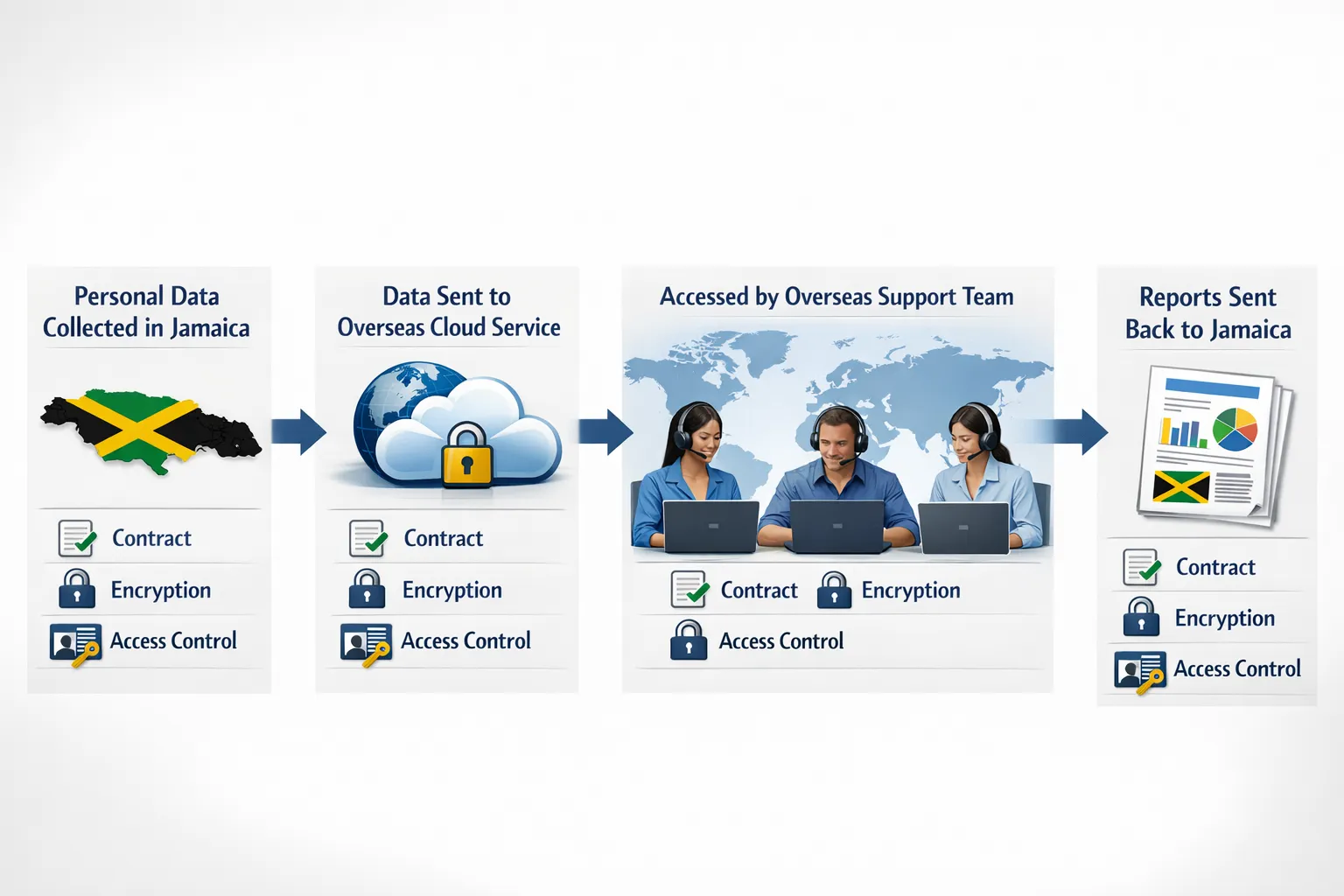
A cross-border transfer generally occurs when personal data is sent, made accessible, or stored outside Jamaica.
That includes obvious situations like hosting a database in the US or Europe. It also includes less obvious patterns that many teams miss:
Remote access from overseas: An IT support provider abroad logs into your HR system or email environment.
Cloud services with global infrastructure: A vendor may store or replicate data across regions for resilience.
Group-wide platforms: A parent company outside Jamaica centralises employee, customer, or marketing data.
Outsourcing: Call centres, claims processing, background checks, and customer support operations may involve overseas personnel and systems.
A useful test is: if the data is viewable or processable outside Jamaica, you should treat it as a cross-border transfer and apply transfer controls.
The core expectation under Jamaica’s Data Protection Act
Jamaica’s Data Protection Act is built on accountability. For cross-border transfers, that typically means:
You understand what personal data is going out of Jamaica.
You can justify why the transfer is necessary.
You have assessed the risks created by the transfer.
You have put safeguards in place so the data remains protected.
You can evidence these steps (not just describe them).
In most compliance programmes, the “transfer decision” sits at the intersection of privacy, information security, procurement, legal, and operations. The organisation needs a consistent approach, otherwise transfers happen through vendor onboarding, IT projects, or business urgency without the documentation needed to defend decisions later.
Common cross-border transfer scenarios for Jamaican organisations
Cross-border transfers show up across industries, including financial services, tourism, education, health, and BPO operations. Here are common examples and what usually needs attention.
Scenario | Example data | Why it becomes a transfer issue | Typical control focus |
Cloud hosting and SaaS tools | Names, emails, login logs, usage analytics | Data stored or accessed outside Jamaica | Vendor due diligence, security measures, data location transparency |
HR and payroll outsourcing | TRN, bank details, salary, leave records | Processors and platforms may be overseas | Processor contract terms, role-based access, retention and deletion |
Customer support and BPO | Call recordings, complaints, IDs, booking details | Agents and tools may be located abroad | Access controls, monitoring, training, onward transfer management |
Marketing platforms | Email lists, segmentation, tracking data | Cross-border marketing infrastructure | Consent and transparency, opt-out controls, minimisation |
Finance and expense management | Employee claims, receipts, card spend data | Many tools are hosted internationally | Processor terms, security controls, data minimisation |
For example, if your finance team adopts a cloud-based budgeting and expense tool like the MoneyPatrol expense tracker, you should treat it as a vendor relationship that may involve cross-border processing, then confirm what data is collected, where it is stored, who can access it, and what contractual safeguards apply.
A practical 7-part process to manage cross-border transfers
Most organisations do not fail because they “transferred data”. They fail because they cannot show they managed the transfer responsibly.
1) Build and maintain a transfer register
Start with a list of systems and vendors that touch personal data and identify which ones involve seen or likely cross-border access or storage. Your register should be easy to update during onboarding and project change, not a once-a-year spreadsheet.
At minimum, capture:
System/vendor name and business owner
Categories of personal data involved
Transfer destination(s), if known
Purpose of transfer
Whether the vendor is a controller or processor (or both)
2) Define the lawful purpose and necessity
Teams should be able to answer: why are we transferring this data, and is it necessary to transfer all of it?
This is where minimisation makes a measurable difference. If a vendor only needs an employee ID and reimbursement total, do not also send full receipts with unrelated sensitive details (or redact them first).
3) Perform a risk-based transfer assessment
A transfer assessment does not need to be academic, but it should be consistent and documented.
Key questions to document include:
What harm could occur if the data is misused, exposed, or accessed improperly?
How sensitive is the data (financial, health, children’s data, IDs)?
How many people are affected?
Who will access the data, and from where?
What security controls are in place, and can you verify them?
4) Put safeguards in place (then verify them)
Safeguards are typically a combination of:
Contractual controls: clear obligations on confidentiality, security, breach notification, and deletion.
Technical controls: encryption, MFA, least-privilege access, logging, secure backups.
Organisational controls: training, approved workflows, periodic audits or reviews.
Avoid relying solely on marketing claims like “enterprise-grade security”. You should aim to verify controls through vendor documentation, audits, security questionnaires, or evidence from independent certifications where appropriate.
5) Update your privacy notices and internal transparency
If personal data is transferred outside Jamaica, individuals should be informed in a meaningful way (not buried in vague language). In practice, you want internal alignment too: customer-facing teams, HR, and IT should all understand what is being transferred and why.
6) Prepare for rights requests across borders
If an individual makes an access, correction, or deletion request, can you execute it if the data sits in an overseas system?
A good cross-border transfer programme ensures:
You know where the data is stored.
You know who can action requests in the vendor environment.
Vendor timelines and responsibilities are clear.
7) Monitor, review, and re-approve transfers when things change
Cross-border risk changes over time. Vendors add sub-processors, move infrastructure, change ownership, or introduce new product features.
Build triggers for review, such as:
New categories of data added
New destination country added
Security incident or breach
Contract renewal
What to document: a “transfer pack” you can defend
When regulators, auditors, or clients ask, “How did you decide this transfer was acceptable?”, you want a clear file you can produce quickly.
Here is a practical documentation set many organisations use.
Document or evidence | What it shows | Practical examples |
Transfer register entry | You are tracking transfers systematically | System inventory with vendor owners and destinations |
Vendor due diligence | You assessed the provider before sharing data | Security questionnaire, SOC 2 summary, ISO/IEC 27001 certificate (if available), penetration test summary |
Contract / DPA clauses | The vendor is bound to protect the data | Processing terms, sub-processor controls, deletion obligations |
Risk assessment record | You considered sensitivity and impact | Internal risk worksheet, sign-off workflow |
Technical security evidence | Controls exist beyond paper commitments | MFA enforced, encryption at rest/in transit, access logs, SSO policy |
Incident and breach procedures | You can respond quickly | IR plan references, breach notification path |
The goal is not paperwork for its own sake. The goal is being able to demonstrate accountability.
Contract clauses that matter most for cross-border transfers
Well-written vendor agreements reduce uncertainty when something goes wrong, and they create leverage to enforce your expectations.
For cross-border transfers, pay particular attention to:
Clear roles: whether the vendor is acting as a processor, controller, or both.
Purpose limitation: the vendor should only process data on documented instructions.
Security requirements: baseline measures (access controls, encryption, vulnerability management).
Breach notification: defined timeframes and required details.
Sub-processor controls: approval process, visibility into sub-processors, flow-down obligations.
Data retention and deletion: how data is returned or destroyed at end of service.
Audit and assurance: ability to receive evidence and conduct reasonable oversight.
If your procurement process treats privacy terms as “standard legal text” and rushes signature, cross-border risk will accumulate quickly.
Operational controls that reduce cross-border risk fast
Even with strong contracts, operational control gaps can create exposure. These are high-impact improvements most organisations can implement without a major rebuild:
Least-privilege access for overseas support teams and vendors, with time-bound access where possible.
Centralised identity and MFA for systems that contain customer and employee personal data.
Logging and monitoring for privileged access.
Clear data handling rules for exports, downloads, and email forwarding.
Retention schedules that apply equally to overseas systems.
Cross-border red flags to watch for
Some transfer risks are not obvious at onboarding, but they show up in vendor responses and operational behaviour.
Treat these as escalation triggers:
The vendor cannot tell you where your data is stored or accessed.
The vendor refuses to disclose sub-processors.
“Support” requires broad admin access for routine tasks.
The vendor’s breach notification language is vague or open-ended.
Your team is exporting spreadsheets to send overseas because “the system can’t do it”.
These are not always deal-breakers, but they should lead to deeper due diligence and stronger safeguards.
If you receive personal data from overseas into Jamaica
Cross-border transfer obligations are not only outbound. Jamaican companies that provide services to overseas clients (including BPO, HR services, analytics, and IT support) often receive personal data from other jurisdictions.
In practice, this means:
You may be required to meet your client’s transfer and security expectations contractually.
You should be prepared to demonstrate your controls, training, and incident readiness.
Your internal governance should clearly define who is accountable for privacy and data protection.
A mature transfer programme can become a competitive advantage in winning and keeping overseas contracts.
Frequently Asked Questions
Does using cloud services automatically mean we are transferring personal data outside Jamaica? Often, yes. Many cloud providers store, replicate, or support data from outside Jamaica. Even if data is “hosted in one region,” remote access by overseas personnel can still create a cross-border transfer scenario.
Do we need consent for cross-border transfers under Jamaica’s Data Protection Act? Consent may be one option in certain situations, but it is not always the best foundation, especially for employee data or where individuals have limited choice. Organisations typically need to rely on broader lawful and accountable processing, supported by safeguards and clear transparency.
What evidence should we keep to prove we managed cross-border transfers correctly? Keep a transfer register, vendor due diligence records, risk assessments, relevant contract terms, and proof of security controls (like MFA, encryption, and access logging), plus documented procedures for incidents and rights requests.
Is remote support from an overseas vendor considered a transfer? It can be. If overseas personnel can access personal data (even for troubleshooting), treat it as a transfer and apply access controls, logging, and contract safeguards.
How often should we review cross-border transfers? Review on a defined cycle (for example annually) and whenever there is a meaningful change, such as new data categories, new sub-processors, new countries involved, or a security incident.
Need help operationalising cross-border transfer compliance?
Cross-border transfers are one of the easiest places for compliance gaps to hide, especially when procurement, IT, and operations move faster than governance.
Privacy & Legal Management Consultants Ltd. (PLMC) helps Jamaican organisations build practical, evidence-based programmes for data protection implementation, vendor oversight, risk assessments, and role-based training. If you want support mapping cross-border transfers, strengthening vendor contracts, or building a defensible transfer assessment process, visit Privacy & Legal Management Consultants Ltd. to request a consultation and access resources designed for Jamaica’s compliance environment.